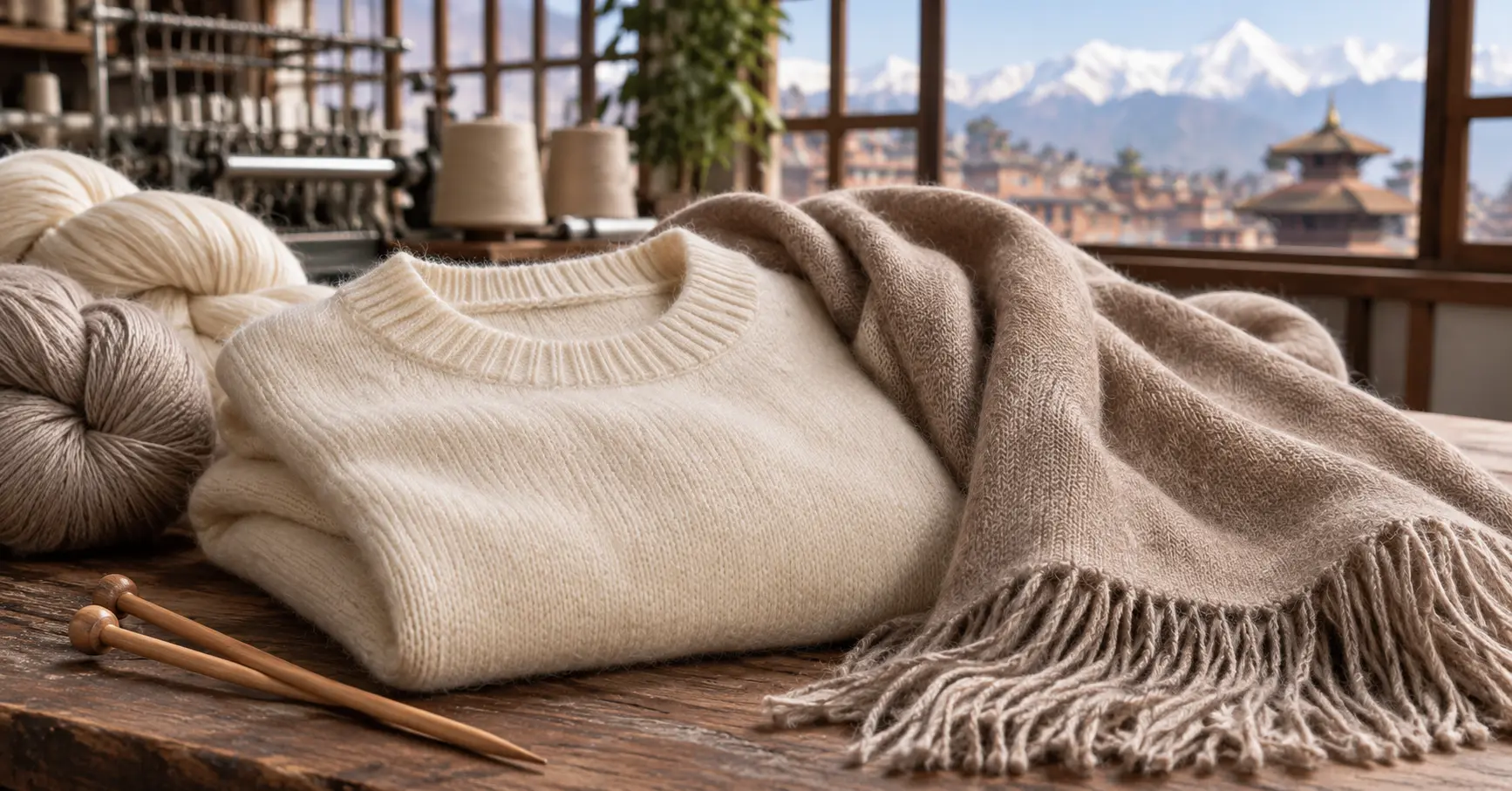
Nepal has earned international recognition for its traditional textile craftsmanship and the exceptional natural fibers found in the Himalayan region. Among its most treasured materials is Chyangra Pashmina, a fine natural fiber obtained from the soft undercoat of Chyangra goats raised in the high-altitude Himalayan regions.
Known for its exceptional softness, lightweight warmth, and luxurious texture, Nepalese cashmere has become an important part of the country’s premium textile and knitwear industry. From traditional shawls and scarves to contemporary sweaters and cardigans, this remarkable fiber brings together natural quality, skilled craftsmanship, and modern textile production.
Today, cashmere manufacturing in Nepal combines traditional knowledge with modern knitting, weaving, finishing, and quality-control techniques to serve customers around the world.
At Rita Cashmere, based in Kathmandu, Nepal, we have been manufacturing premium cashmere and wool products since 2013. Working with authentic Nepalese Chyangra Pashmina, we produce cashmere knitwear and accessories for international brands, retailers, wholesalers, and private-label businesses.
In this guide, we explore what makes Nepalese cashmere special, how Chyangra Pashmina is transformed into finished products, and why Nepal continues to be an important destination for premium cashmere manufacturing.
What Makes Cashmere in Nepal Special?
Nepal’s connection with cashmere is closely associated with the Himalayan landscape, the Chyangra goat, and the country’s longstanding textile traditions.
The cold Himalayan environment encourages Chyangra goats to develop a soft insulating undercoat beneath their coarser outer hair. This fine undercoat is the source of Chyangra Pashmina, a highly valued natural textile fiber.
Several characteristics make Nepalese cashmere particularly desirable:
- Exceptional softness: Fine natural fibers create a soft and comfortable feel against the skin.
- Lightweight warmth: Cashmere provides excellent insulation without the bulk associated with heavier fabrics.
- Versatility: The fiber can be developed into knitwear, scarves, shawls, stoles, and other textile products.
- Natural appeal: Cashmere offers a distinctive combination of comfort, texture, and elegant drape.
- Craftsmanship: Its transformation into finished garments requires careful material selection, technical knowledge, and skilled production.
Nepal’s cashmere industry connects natural Himalayan resources with the skills of local textile producers and manufacturers.
To understand the fiber in greater detail, read our guide to Chyangra Pashmina and Nepal’s Himalayan cashmere heritage.
Understanding Chyangra Pashmina: The Heritage of Nepalese Cashmere
Chyangra Pashmina is a distinctive category of fine Himalayan cashmere associated with Nepal’s Chyangra goats.
The fiber is collected from the animals’ naturally shedding undercoat, traditionally during the seasonal molting period. It is then prepared and processed into yarn suitable for different textile applications.
The name Chyangra Pashmina is particularly important because it provides a connection between the fiber’s origin, product quality, and Nepalese textile identity.
How Is Authentic Chyangra Pashmina Verified?
Authenticity is an important consideration in the international cashmere market. Products sold as Pashmina may vary considerably in their fiber composition, origin, and quality.
The Chyangra Pashmina trademark and certification framework promoted by the Nepal Pashmina Industries Association (NPIA) provides defined criteria for participating manufacturers.
Its published quality requirements include:
- Fiber diameter not exceeding 17 microns.
- A minimum of 97% Pashmina fiber in yarn under its stated purity criterion.
- Defined requirements concerning fiber composition and permitted blends.
- Color-fastness requirements.
- Restrictions on harmful AZO dyes.
These criteria help distinguish quality-controlled Chyangra Pashmina products from textiles that use the Pashmina name without equivalent verification.
For more information, consult the Chyangra Pashmina certification standards.
At Rita Cashmere, we work with NPIA-certified Nepalese Chyangra Pashmina and quality-verified yarns to support consistent product quality and authenticity.
How Is Cashmere Knitwear Manufactured in Nepal?
Cashmere knitwear manufacturing in Nepal combines careful material selection with specialized textile production techniques.
The exact process varies according to the product, fiber grade, yarn specification, construction method, and finishing requirements. However, producing a quality cashmere garment generally involves several important stages.
1. Cashmere Fiber Sourcing and Selection
The process begins with sourcing suitable raw materials.
Cashmere fiber is selected according to its quality, fineness, purity, and intended application. For premium Nepalese products, Chyangra Pashmina is an important material because of its recognized origin and fine fiber characteristics.
Reliable sourcing and appropriate material verification are essential for maintaining consistency throughout production.
2. Cleaning and Fiber Preparation
Collected raw cashmere requires careful preparation before it can become usable yarn.
Depending on the material’s condition and the supplier’s processing stage, preparation may involve cleaning, sorting, and separating fine undercoat fibers from coarser hair and unwanted impurities.
Proper preparation helps improve the consistency, softness, and quality of the resulting yarn.
3. Cashmere Yarn Selection and Preparation
Yarn selection plays a significant role in determining the appearance, weight, texture, and performance of the final garment.
Manufacturers consider yarn count, fiber composition, twist, construction, and thickness according to the product being developed.
For example, a lightweight cashmere scarf requires different yarn characteristics from a heavier winter sweater.
At Rita Cashmere, yarn selection and preparation are important parts of our production planning. We work with verified cashmere yarns to develop products suitable for different designs and customer requirements.
4. Knitting and Weaving
Once the yarn is ready, it can be transformed into fabric or finished textile products through knitting or weaving.
Knitting is commonly used for garments such as:
- Cashmere sweaters and pullovers.
- Cashmere cardigans.
- Turtleneck sweaters.
- Cable-knit garments.
- Cashmere beanies and gloves.
Weaving is commonly used for scarves, shawls, stoles, and other textile accessories.
The construction method affects the garment’s texture, flexibility, thickness, appearance, and drape.
Skilled production teams work with appropriate techniques and equipment to maintain accurate dimensions and consistent construction.
5. Dyeing and Color Development
Color is another important aspect of cashmere manufacturing.
Natural cashmere is available in several shades, including off-white, beige, grey, and brown. For colored collections, dyeing techniques are used to develop different shades and finishes.
Manufacturers must carefully consider dye compatibility, color consistency, and the delicate nature of the fiber.
For brands developing customized collections, color matching is particularly important. Consistent colors help maintain a unified appearance across sweaters, cardigans, scarves, and accessories.
6. Finishing and Quality Inspection
After knitting or weaving, finished products undergo additional processing and inspection.
Depending on the product, finishing may include washing, drying, pressing, shaping, trimming, and other garment-finishing procedures.
Quality checks can include:
- Measurement and dimensional accuracy.
- Stitching and construction quality.
- Surface appearance and consistency.
- Color uniformity.
- Finishing details.
- Label and packaging accuracy.
This stage is important because premium cashmere is judged not only by its raw material but also by the quality of the finished product.
At Rita Cashmere, quality control is incorporated into our production workflow to help ensure that finished orders meet the agreed specifications.
Cashmere Knitwear Manufacturing in Kathmandu, Nepal
Kathmandu is an important center for Nepal’s textile manufacturing, export, and cashmere-related production activities.
The city provides access to textile professionals, manufacturing facilities, suppliers, skilled craftspeople, and export infrastructure.
For international buyers, working directly with a Nepal-based cashmere manufacturer can provide an opportunity to source products close to the country’s established Pashmina industry.
Meet Rita Cashmere: A Nepalese Cashmere Manufacturer Since 2013
Established in 2013, Rita Cashmere is a Kathmandu-based manufacturer, exporter, and wholesaler specializing in premium cashmere, Pashmina, and wool products.
We combine Nepalese textile craftsmanship with modern production methods to develop cashmere products for international customers.
Our manufacturing capabilities include:
- Cashmere sweaters and pullovers.
- Cashmere cardigans.
- Cashmere scarves and shawls.
- Cashmere stoles and wraps.
- Cashmere beanies and accessories.
- Custom-designed cashmere knitwear.
We work with different yarn specifications, garment styles, colors, and construction requirements to serve a range of product development needs.
Learn more about Rita Cashmere and our manufacturing background.
Explore Cashmere Knitwear from Nepal
Nepalese cashmere is versatile enough to create a wide range of premium garments and accessories.
Each product category has its own construction, styling, and material requirements.
Cashmere Sweaters
Cashmere sweaters are valued for their softness, warmth, and versatility. Popular designs include crew-neck, V-neck, turtleneck, cable-knit, and contemporary relaxed-fit styles.
They can be developed for men’s and women’s collections, with different yarn specifications, colors, and sizes.
Cashmere Cardigans
Cashmere cardigans combine warmth with practical layering. Button-front, open-front, cable-knit, and shawl-collar designs are popular options for premium knitwear collections.
Their construction can be customized according to the brand’s design direction.
Cashmere Scarves and Shawls
Scarves and shawls are among the most recognized applications of Nepalese Pashmina.
Their lightweight feel, soft texture, and versatility make them suitable for everyday accessories, luxury gifting, and premium fashion collections.
Different sizes, patterns, colors, and edge finishes allow manufacturers to create distinctive designs.
Cashmere Stoles and Accessories
Cashmere stoles, wraps, beanies, gloves, and other accessories offer additional opportunities for brands looking to expand their collections.
These products can be developed in different weights, textures, and designs depending on seasonal requirements.
Explore our Nepalese cashmere knitwear collection to discover the different products available from Rita Cashmere.
You can also explore our cashmere scarf collection and cashmere cardigan collection.
Responsible Cashmere Sourcing and Quality
Responsible sourcing is an increasingly important consideration for businesses purchasing natural fibers.
For international fashion brands, product quality must be considered alongside material origin, supplier transparency, animal welfare, manufacturing practices, and relevant certification requirements.
When evaluating a cashmere supplier, buyers should consider:
Material authenticity: Understand where the cashmere originates and request relevant fiber composition and product documentation.
Animal welfare: Ask suppliers about responsible fiber collection and the practices used throughout the sourcing process.
Manufacturing standards: Understand how products are knitted, dyed, finished, and inspected.
Worker welfare: Consider the working conditions, skills development, and compensation practices within the supply chain.
Certification and documentation: Verify applicable certifications, their validity, and the products or production stages they cover.
Rita Cashmere describes its production approach as aligned with relevant GOTS principles and Sustainable Fibre Alliance practices. Buyers with specific certification requirements should request current documentation and confirm the applicable certification scope before placing orders.
Responsible manufacturing requires more than broad sustainability statements. Transparency and verifiable production practices are essential.
Why Choose a Nepalese Cashmere Manufacturer?
Choosing the right manufacturing partner is an important decision for fashion brands, wholesalers, and retailers.
Working with a specialist cashmere manufacturer in Nepal offers several potential advantages.
1. Access to Nepalese Chyangra Pashmina
Nepal has a recognized identity in the international Pashmina industry. Working with a manufacturer experienced in Chyangra Pashmina can help businesses develop products connected to this distinctive Himalayan textile tradition.
2. Specialized Cashmere Manufacturing Experience
An experienced manufacturer understands the technical requirements involved in cashmere yarn selection, garment construction, finishing, and quality inspection.
This expertise helps translate product concepts into finished garments that meet defined specifications.
3. Custom Product Development
Businesses often require products that reflect their own brand identity rather than standard catalogue designs.
Custom manufacturing provides opportunities to develop specific styles, colors, sizes, knit patterns, labels, and packaging.
4. Wholesale and Private-Label Opportunities
Working directly with a manufacturer can support different business models, including wholesale sourcing, OEM production, ODM development, and private-label collections.
These options allow established retailers and emerging fashion businesses to develop their product ranges according to their commercial needs.
5. Direct Communication and Manufacturing Coordination
Working with a manufacturer based in Kathmandu provides direct communication with the production team and access to the product development process.
Clear specifications, sampling, approvals, and quality checks help establish a more reliable manufacturing relationship.
Custom Cashmere Manufacturing: OEM, ODM and Private Label Services
Modern fashion brands require flexibility in how their products are developed and manufactured.
At Rita Cashmere, we offer bespoke manufacturing solutions for businesses seeking customized Nepalese cashmere products.
Our services include:
OEM Manufacturing: Products are developed and manufactured according to the buyer’s designs, technical specifications, and requirements.
ODM Manufacturing: Buyers can work with existing design capabilities and manufacturing expertise to develop suitable products for their brand.
White-Label Manufacturing: Businesses can select products from an existing collection and apply their own branding, labels, and packaging.
Private-Label Manufacturing: Brands can develop customized products with specific designs, colors, measurements, branding, and finishing requirements.
From design development and sampling to production, inspection, and packaging, these services help businesses create collections that reflect their market positioning.
Discover our bespoke cashmere manufacturing services or explore our white-label and private-label cashmere manufacturing options.
Frequently Asked Questions About Cashmere in Nepal
What is Nepalese cashmere?
Nepalese cashmere is a fine natural animal fiber associated with Nepal’s Himalayan textile industry. Chyangra Pashmina, obtained from the soft undercoat of Chyangra goats, is one of the country’s most distinctive and recognized premium fibers.
What is Chyangra Pashmina?
Chyangra Pashmina is a fine Himalayan natural fiber obtained from the undercoat of Chyangra goats raised in high-altitude regions. It is valued for its softness, lightweight warmth, and connection to Nepal’s traditional textile industry.
Is Pashmina the same as cashmere?
Pashmina and cashmere are closely related terms, but they are not always used identically in the international textile market. Cashmere is the broader fiber category, while Pashmina commonly refers to particularly fine cashmere associated with Himalayan production and specific textile traditions. Chyangra Pashmina identifies the Nepalese category promoted through the NPIA trademark.
How is cashmere knitwear manufactured in Nepal?
Cashmere knitwear manufacturing generally involves material sourcing, fiber and yarn preparation, knitting or weaving, dyeing when required, finishing, quality inspection, and packaging. The exact process depends on the product and manufacturing specifications.
Where is cashmere manufactured in Nepal?
Kathmandu is an important location for Nepalese cashmere manufacturing. It provides access to textile manufacturing facilities, skilled production teams, suppliers, and export services. Rita Cashmere operates its manufacturing business from Kathmandu.
How can buyers verify authentic Nepalese Pashmina?
Buyers should look for relevant Chyangra Pashmina certification, request product-specific documentation, and verify fiber composition and applicable quality standards. The NPIA certification framework provides published requirements for products using the Chyangra Pashmina label.
Does Rita Cashmere manufacture wholesale cashmere knitwear?
Yes. Rita Cashmere supplies cashmere knitwear and accessories to wholesale buyers, retailers, and international fashion businesses. Its product range includes sweaters, cardigans, scarves, shawls, stoles, and other accessories.
Does Rita Cashmere offer private-label cashmere manufacturing?
Yes. Rita Cashmere offers OEM, ODM, white-label, and private-label manufacturing services. Businesses can discuss customized designs, colors, sizes, branding, labels, and packaging requirements directly with the company.
Can international brands source cashmere products from Nepal?
Yes. International fashion brands, retailers, and wholesalers can work with Nepalese manufacturers to source premium cashmere products. Buyers should evaluate material authenticity, product specifications, manufacturing capabilities, quality-control procedures, export documentation, and delivery requirements before selecting a supplier.
Discover the Craftsmanship of Nepalese Cashmere with Rita Cashmere
Cashmere in Nepal represents an important connection between natural Himalayan fibers, traditional textile knowledge, and modern manufacturing.
From authentic Chyangra Pashmina to premium sweaters, cardigans, scarves, and shawls, Nepalese cashmere continues to offer opportunities for businesses seeking quality natural-fiber products.
At Rita Cashmere, we bring together manufacturing experience, Nepalese craftsmanship, and product development capabilities to serve international brands, wholesalers, retailers, and private-label businesses.
Established in Kathmandu in 2013, we work with Nepalese cashmere and Pashmina to develop products that combine comfort, quality, and thoughtful design.
Whether you are sourcing ready-made cashmere knitwear or developing a customized collection for your brand, our team is ready to discuss your requirements.
Looking for a reliable cashmere knitwear manufacturer in Nepal?
Explore our cashmere knitwear collection or contact Rita Cashmere to discuss wholesale, OEM, ODM, and private-label manufacturing opportunities.
Rita Cashmere – Pure Nepal. Pure Luxury.
Authentic Nepalese Cashmere | Kathmandu, Nepal | Wholesale | OEM | ODM | Private Label