
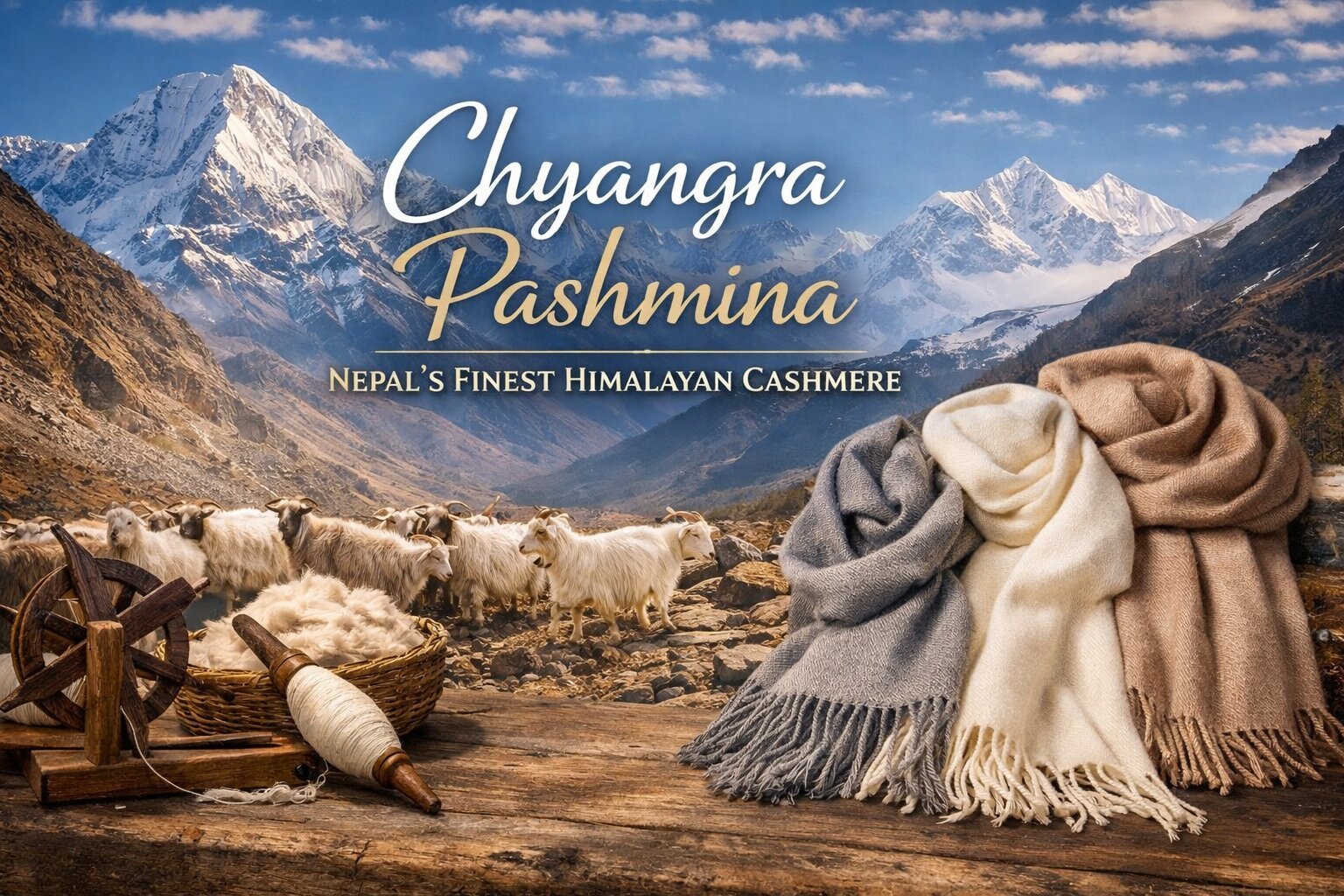
Chyangra Pashmina is the world’s finest and rarest form of cashmere, sourced from the ultra-soft undercoat of Himalayan mountain goats known as Capra hircus, locally called Chyangra in Nepal. These goats live at extreme altitudes above 14,000 feet in the harsh Himalayan climate. To survive the freezing temperatures, they naturally grow an incredibly fine insulating fiber. This fiber is carefully hand-combed during the molting season and traditionally hand-spun and woven by skilled Nepalese artisans to create authentic Pashmina products known for their exceptional softness, warmth, lightness, and durability. Chyangra Pashmina is also an important sustainable livelihood for Himalayan communities and a symbol of Nepal’s rich textile heritage.
Why Chyangra Pashmina Is the Most Sought-After Fiber in Global Luxury Textiles
The modern global market for Chyangra Pashmina has grown significantly as luxury brands and textile buyers increasingly seek authentic, traceable natural fibers. With rising awareness around sustainability, ethical sourcing, and craftsmanship, genuine Himalayan Pashmina has become one of the most desirable fibers in the luxury textile industry.
However, the growing popularity of Pashmina has also led to widespread misuse of the term in global markets. Many products labeled as “pashmina” are actually blends of viscose, silk, acrylic, or lower-grade cashmere that do not meet the traditional standards of authentic Himalayan Pashmina. For serious buyers, designers, and textile professionals, understanding the true origin, fiber characteristics, and production methods of genuine Chyangra Pashmina is essential.
Authentic Chyangra Pashmina can only be produced from the fine undercoat of Chyangra goats raised in the high-altitude Himalayan regions of Nepal. The fiber must meet strict micron standards and undergo traditional processing methods that preserve its natural softness, warmth, and durability. Organizations such as the Nepal Pashmina Industries Association (NPIA) and international fiber testing laboratories play an important role in verifying authenticity and maintaining quality standards across the industry.
For buyers, brands, and textile professionals, understanding these factors helps ensure that the products they source and sell truly represent the heritage, craftsmanship, and quality associated with genuine Himalayan Chyangra Pashmina.
What Is Chyangra Pashmina?
Chyangra Pashmina is a certified, ultra-fine natural fiber obtained exclusively from the Chyangra goat — a breed of Capra hircus indigenous to the high-altitude Himalayan regions of Nepal, particularly in districts such as Mustang, Dolpa, Humla, Jumla, and Manang, where elevations range from 14,000 to 17,000 feet above sea level.
The word “Pashmina” derives from the Persian word pashm, meaning soft gold or soft fiber. In the Nepalese context, Chyangra Pashmina specifically refers to fiber that meets the strict national and international standards set by the Nepal Pashmina Industries Association (NPIA) — a distinction that separates it from the vast volume of lower-grade cashmere commercially labeled and sold as “pashmina” in global markets.
Chyangra Pashmina fiber measures between 12 to 16 microns in diameter — significantly finer than standard commercial cashmere (which typically measures 18 to 21 microns) — giving it an extraordinarily soft, smooth hand-feel that is virtually unmatched by any other natural fiber except Vicuña.
For wholesale buyers, this micron difference is not merely a technical detail. It directly translates into a product that commands higher retail prices, stronger brand positioning, lower customer return rates, and unmatched customer loyalty in the luxury segment.
The Chyangra Goat: Origin and Habitat
The Chyangra goat (Capra hircus) is a hardy, domesticated mountain goat that has evolved over thousands of years to survive the extreme cold of the Nepalese Himalayas. These goats are raised by nomadic herding communities — primarily the Loba people of Mustang and the Khampa communities of the Trans-Himalayan belt — who have maintained traditional herding practices for centuries.
Why High Altitude Matters
The extreme climatic conditions at elevations above 14,000 feet are the biological reason why Chyangra Pashmina is so fine and so warm. At these altitudes, temperatures routinely drop to -40°C in winter. In response, the Chyangra goat develops an exceptionally dense, fine inner coat — the pashm — beneath its coarser outer hair. This inner coat is a natural thermal insulation system so efficient that it produces a fiber with the highest warmth-to-weight ratio of any commercially available natural textile fiber.
Goats raised at lower altitudes, in different climates, or of different breeds simply do not produce the same quality of fiber. This is a biological and geographical fact — not a marketing claim. For wholesale buyers conducting supplier due diligence, it is the single most important factor to understand when verifying fiber origin.
The Herding Communities
The primary herders are small-scale, family-based operations in remote Himalayan districts. Each Chyangra goat produces only 80 to 170 grams of usable pashm per year — an inherently limited supply that is the key driver of the fiber’s premium pricing and scarcity value in global markets.
Rita Cashmere sources its Chyangra Pashmina fiber exclusively from these high-altitude Himalayan regions, with NPIA-verified and SGS-certified raw materials entering the Kathmandu manufacturing facility — ensuring full traceability from Himalayan source to finished product.
What Makes Chyangra Pashmina Different from Regular Cashmere?
This is the most commercially critical distinction wholesale buyers must understand, particularly when communicating product value to retail buyers and end consumers.
| Feature | Chyangra Pashmina | Standard Cashmere |
|---|---|---|
| Fiber Diameter | 12–16 microns | 18–21 microns |
| Source Animal | Capra hircus (Himalayan, Nepal) | Various Capra hircus breeds globally |
| Altitude of Origin | 14,000–17,000 feet | Various (often lowland) |
| Annual Yield per Goat | 80–170 grams | 150–350 grams |
| Production Method | 100% handspun, handwoven | Often machine-processed |
| Certification | NPIA certified, Nepal GI protected | No standardized certification |
| Warmth-to-Weight Ratio | Exceptional | Good |
| Softness | Exceptionally fine | Soft, but coarser |
| Price Point | Premium / Ultra-luxury | Mid to high |
| Retail Market Positioning | Ultra-luxury, bespoke | Luxury to premium |
The Micron Advantage
To put the micron difference in clear commercial terms: a fiber measuring 14 microns is almost imperceptibly fine to the touch — it does not itch, does not pill easily, and retains its texture and structure even after repeated washing. Standard cashmere at 19–21 microns, while still soft, is noticeably coarser by comparison and more prone to pilling over time.
For wholesale buyers supplying luxury retail brands, boutiques, or private label collections, the micron specification of Chyangra Pashmina is your most powerful product differentiator.
Fiber Specifications: Micron Count, Staple Length, and Grade
Understanding the technical fiber specifications of Chyangra Pashmina is essential for wholesale procurement, quality control, and product specification sheets.
Micron Count
- Grade A (Ultra Fine): 12–14 microns — the finest available; used for premium shawls, wraps, and scarves
- Grade B (Fine): 14–16 microns — standard high-grade Chyangra Pashmina; suitable for a wide range of luxury textile products
- Below 16 microns: Not classified as authentic Chyangra Pashmina under NPIA standards
Staple Length
The average staple length of Chyangra Pashmina fiber ranges from 25 to 90 mm, which is ideal for handspinning — a longer staple produces smoother, stronger yarn with minimal shedding.
Yarn Counts at Rita Cashmere
Rita Cashmere works with precision yarn counts of 2/26 NM, 2/28 NM, and 2/30 NM — offering varying levels of fineness and softness to suit different product requirements and wholesale market positioning. These yarn specifications allow buyers to select the exact product weight and handle that best fits their retail customer profile.
Color
Raw Chyangra Pashmina fiber is available in natural shades of white, off-white, grey, and brown. White fiber commands the highest price because it accepts natural and chemical dyes most evenly, enabling the rich, consistent coloration that luxury buyers demand. Rita Cashmere uses eco-conscious, GOTS-aligned dyeing processes to achieve vibrant, consistent color while minimizing environmental impact.
The Harvesting Process: How Chyangra Fiber Is Collected
One of the most important ethical and quality differentiators of authentic Chyangra Pashmina is how the fiber is harvested. Unlike sheep’s wool, Pashmina fiber is never shorn with blades. There are two traditional harvesting methods:
Combing
The most widely used and preferred method. A fine-toothed wooden or metal comb is gently drawn through the goat’s undercoat during the natural spring molting season (March to May), collecting the loose pashm as the goat naturally sheds its winter coat. Combing is gentle, non-stressful to the animal, and produces the highest quality fiber with minimal contamination from coarse guard hair.
Plucking
In some communities, fibers are carefully hand-plucked during molting. This method is more labor-intensive but also produces excellent quality fiber.
Animal Welfare and Ethical Sourcing
Rita Cashmere’s fiber sourcing fully adheres to Sustainable Fibre Alliance (SFA) principles — ensuring Chyangra goats are raised in natural Himalayan environments, harvested only during the natural shedding season, and never subjected to harmful or intensive farming practices. For wholesale buyers whose retail brands carry ESG or ethical sourcing commitments, this is a fully documentable, auditable supply chain standard.
From Raw Fiber to Finished Product: The Handcraft Process
What truly distinguishes Chyangra Pashmina from industrially produced cashmere is the entirely handcrafted production chain. At Rita Cashmere’s Kathmandu manufacturing facility, every stage — from raw fiber cleaning to the finished shawl, scarf, or knitwear piece — is executed by skilled master artisans using traditional Nepalese techniques enhanced by modern precision and quality control.
Stage 1: Sorting and Cleaning (Panje)
Raw harvested fiber is sorted by hand to remove coarse guard hairs, vegetable matter, and debris. This initial sorting is critical — removing even a small percentage of coarse fiber significantly improves the final product’s softness and uniformity.
Stage 2: Dehairing
Fine mechanical dehairing separates the fine pashm from any remaining coarse fibers. At Rita Cashmere, only NPIA-verified and SGS-certified materials proceed past this stage.
Stage 3: Washing
The dehaired fiber is washed gently using mild, eco-conscious cleansing agents in temperature-controlled water to remove natural oils and remaining impurities without damaging the delicate fiber structure.
Stage 4: Handspinning (Bhagnak)
Skilled Nepalese artisans use the traditional hand spindle — the takli — to spin cleaned fiber into fine, even yarn. Handspun Pashmina yarn has a natural character that gives the finished fabric its distinctive organic texture and superior warmth. Machine-spun yarn, by contrast, lacks the structural depth and insulating properties of handspun Pashmina.
Stage 5: Handweaving and Knitting
The spun yarn is woven on traditional handlooms or knitted by master craftspeople. A single Pashmina shawl measuring 200 cm x 70 cm takes an experienced weaver anywhere from 3 to 5 full working days to complete. Rita Cashmere’s artisan team executes cable patterns, intricate ribbing, and detailed finishing with generations of inherited expertise — each piece a product of decades of mastery.
Stage 6: Eco-Conscious Dyeing and Finishing
For colored products, Rita Cashmere employs GOTS-aligned, low-impact dyeing processes — achieving vibrant, consistent color while minimizing water use and environmental impact. The woven or knitted fabric is then finished with light blocking (stretching to set dimensions) to enhance softness and drape.
Stage 7: Rigorous Quality Control
Every piece undergoes Rita Cashmere’s multi-point inspection protocol: raw material verification, in-process quality monitoring, dimensional accuracy checks, color consistency verification, stitch quality and construction inspection, finishing detail review, and a final 100% inspection before packaging.
Stage 8: NPIA Certification and Export Documentation
Products receive official NPIA certification verifying authentic Nepalese Chyangra Pashmina. Custom labels, tags, and packaging are applied per client specifications. Complete export documentation — certificates of origin, quality reports, and customs compliance paperwork — is prepared for smooth delivery to any global destination.
For wholesale buyers, understanding this production timeline is critical for accurate lead time planning and for communicating genuine product value to your retail buyers and end consumers.
Certifications and Authentication: How to Identify Real Chyangra Pashmina
The single greatest commercial risk for wholesale buyers sourcing Pashmina is counterfeit or adulterated product. The global market is flooded with products labeled “pashmina” that contain significant percentages of viscose, silk, acrylic, or lower-grade cashmere blended with fine fiber. Authentic Chyangra Pashmina is protected by several layers of certification and authentication.
Nepal Pashmina Industries Association (NPIA) Certification
The NPIA is the primary regulatory and certification body for Nepalese Pashmina. NPIA-certified products carry a label and certification documentation that verifies the fiber’s Nepalese origin, fiber composition, and compliance with quality standards. Rita Cashmere is a proud certified member of the NPIA — every product manufactured carries this certification, giving wholesale buyers a legally defensible guarantee of authenticity.
SGS-Certified Yarns
Rita Cashmere exclusively uses SGS-certified yarns — raw materials independently verified by SGS, one of the world’s most respected testing and certification organizations. This third-party material certification provides quality assurance before production even begins, giving wholesale buyers confidence in the raw material foundation of every order.
Chyangra Pashmina Geographical Indication (GI)
Nepal has registered Chyangra Pashmina as a Geographical Indication (GI) product — a legal protection mechanism equivalent to Champagne (France) or Darjeeling Tea (India). Only Pashmina produced from Chyangra goats in Nepal’s designated Himalayan regions can legally be sold under the “Chyangra Pashmina” name. For wholesale buyers, GI-certified product provides legal protection against counterfeit claims and is increasingly demanded by luxury retailers across Europe, North America, and East Asia.
GOTS and SFA Alignment
Rita Cashmere’s production practices align with the Global Organic Textile Standard (GOTS) and Sustainable Fibre Alliance (SFA) principles — internationally recognized frameworks for sustainable, ethical, and socially responsible textile manufacturing. These alignments are increasingly required by luxury retail buyers with formal ESG sourcing policies.
ISO 17751 Fiber Testing
Authentic Chyangra Pashmina should always be verifiable through independent fiber testing under ISO 17751 — the international standard for testing fine animal fibers. Wholesale buyers placing significant orders should request lab test certificates confirming mean fiber diameter (microns), fiber composition (100% Capra hircus for pure Pashmina), and absence of synthetic fiber adulteration.
The Pashmina Hallmark Label
The Government of Nepal has introduced a Pashmina Hallmark Label — a tamper-proof, QR-code-enabled label that allows buyers and consumers to verify product authenticity digitally. Wholesale buyers should ensure supplier products carry this hallmark before finalizing purchase orders.
Why Wholesale Buyers Choose Chyangra Pashmina — And Rita Cashmere
From a B2B commercial perspective, Chyangra Pashmina from Rita Cashmere offers wholesale buyers a uniquely compelling combination of product superiority, documented provenance, manufacturing reliability, and market positioning advantages that very few other natural fiber suppliers can match.
Unmatched Product Differentiation
In a market saturated with “cashmere” products of varying quality, Chyangra Pashmina’s certified provenance, verifiable fiber specifications, and GI protection give wholesale buyers a genuine, legally defensible product story. This is increasingly valuable to luxury retailers serving informed, research-driven consumers.
13+ Years of Proven Manufacturing Excellence
Rita Cashmere has spent over a decade building a track record of consistent quality and reliable international delivery — serving clients across 30+ countries on six continents. When you partner with Rita Cashmere, you are not placing trust in promises. You are placing trust in a decade-plus track record of thousands of successfully fulfilled wholesale orders.
Direct Manufacturer Advantage — No Intermediaries
Working directly with Rita Cashmere means no middlemen, no markup, no miscommunication. Wholesale buyers receive competitive pricing, clear dialogue, and direct access to the people actually crafting their products. This translates directly into better margins, faster problem resolution, and a more collaborative product development relationship.
Full OEM, ODM, and Private Label Capability
Rita Cashmere provides complete turnkey manufacturing solutions — from initial design development and sampling through production, quality control, NPIA certification, branded packaging, and international shipping. Whether you need custom designs, private label branding, or standard wholesale catalog orders, Rita Cashmere handles the entire process under one roof.
Flexible and Scalable Production
Rita Cashmere accommodates wholesale orders from 50 to 5,000+ pieces — allowing new buyers to start with manageable trial orders and scale confidently as their market demand grows. This flexibility is rare among certified Himalayan cashmere manufacturers and makes Rita Cashmere an accessible entry point for brands of all sizes.
Strong ESG and Sustainability Alignment
Rita Cashmere’s GOTS-aligned, SFA-principled, ethically sourced production model is fully auditable and documentable — giving wholesale buyers the supply chain transparency they need to credibly support their retail brand’s sustainability commitments. Fair wages, safe working conditions, responsible fiber sourcing, and community investment in Nepal’s artisan communities are not marketing narratives at Rita Cashmere. They are verified operational standards.
Strong Price Margin Architecture
The combination of limited annual supply, high-skill handcraft production, and certified authenticity supports a pricing structure that preserves strong gross margins across the wholesale-to-retail value chain. Wholesale buyers can command retail price premiums of 3x to 6x over standard cashmere for well-positioned, certified Chyangra Pashmina products.
Global Market Demand and Positioning
Chyangra Pashmina occupies the ultra-luxury segment of the global cashmere and fine fiber market. Rita Cashmere currently serves wholesale buyers in the following key markets:
North America (USA & Canada): The largest single destination for premium Nepalese Pashmina. Key buyers include luxury department stores, boutique fashion retailers, private label brands, and e-commerce luxury platforms.
Europe (UK, France, Germany, Italy, Netherlands, Spain, Switzerland, Belgium): Deep, historically established markets for luxury shawls, scarves, and accessories. Sustainability certification and GI provenance are especially valued.
Asia-Pacific (Japan, South Korea, Australia, Singapore, Hong Kong, New Zealand): Highly quality-focused markets where fiber specifications and authenticity documentation command strong consumer trust and premium pricing.
Middle East (UAE, Saudi Arabia, Qatar, Kuwait): Strong and growing demand for fine Pashmina products, both for personal luxury and high-value gifting.
South America and Africa: Emerging luxury markets with growing appetite for authentic, certified Himalayan cashmere products.
How to Source Authentic Chyangra Pashmina: A Wholesale Buyer’s Checklist
Use this checklist when evaluating Nepalese Pashmina suppliers and placing wholesale orders. Rita Cashmere meets every point on this list — and provides full documentation for each.
Supplier Verification
- ✅ Confirm the supplier is a registered, certified member of the Nepal Pashmina Industries Association (NPIA)
- ✅ Verify the supplier holds current GI certification for Chyangra Pashmina
- ✅ Request the supplier’s export license and trade documentation
- ✅ Confirm the supplier operates a verifiable manufacturing facility in Nepal
Product Verification
- ✅ Request independent ISO 17751 fiber test certificates for each product line
- ✅ Confirm fiber diameter specification (Grade A: 12–14 microns; Grade B: 14–16 microns)
- ✅ Confirm fiber composition is 100% Capra hircus (or clearly labeled blend percentage)
- ✅ Verify products carry the official Nepal Pashmina Hallmark Label with QR verification
- ✅ Confirm SGS certification of raw yarns used in production
Production and Ethics Verification
- ✅ Confirm production is handspun and handwoven / handknit by skilled Nepalese artisans
- ✅ Verify GOTS-aligned and SFA-principled production practices
- ✅ Confirm ethical fiber harvesting by combing during natural molting season
- ✅ Verify fair labor standards and artisan working conditions
Commercial Terms
- ✅ Confirm MOQ flexibility (Rita Cashmere: from 50 pieces)
- ✅ Establish clear lead times based on handcraft production timelines
- ✅ Confirm OEM / ODM / private label capabilities if required
- ✅ Clarify packaging, labeling, and care instruction specifications
- ✅ Confirm export documentation requirements for your target import market
Frequently Asked Questions (FAQs)
Q: What is the difference between Pashmina and Cashmere?
All Pashmina is cashmere, but not all cashmere is Pashmina. Pashmina specifically refers to fine fiber from Capra hircus goats. Chyangra Pashmina from Nepal’s Himalayas is the finest grade, measuring 12–16 microns versus the 18–21 microns of standard commercial cashmere.
Q: How can I verify that a Pashmina product is authentic?
Request the Nepal Pashmina Hallmark Label with QR code, NPIA certification documentation, SGS yarn certification, and an independent ISO 17751 fiber test certificate. Rita Cashmere provides all of these with every wholesale order.
Q: What yarn counts does Rita Cashmere work with?
Rita Cashmere works with 2/26 NM, 2/28 NM, and 2/30 NM yarn counts, offering varying levels of fineness and softness to match different product categories and retail price points.
Q: What is the minimum order quantity for wholesale?
Rita Cashmere accepts wholesale orders from as few as 50 pieces, making it accessible for brands beginning their Chyangra Pashmina product line as well as established buyers scaling to 5,000+ pieces.
Q: Does Rita Cashmere offer private label and OEM manufacturing?
Yes. Rita Cashmere provides full OEM, ODM, and private label manufacturing services — including custom design development, sampling, branded packaging, NPIA certification, and export-ready delivery.
Q: Is Chyangra Pashmina production sustainable?
Yes. Rita Cashmere’s production is GOTS-aligned and SFA-principled — low-volume, community-based, ethically sourced, and entirely natural. The company directly supports the livelihoods of herding communities and skilled artisans in Nepal.
Q: How long does it take to produce a Chyangra Pashmina shawl?
A single handwoven Pashmina shawl requires 3 to 5 full working days for an experienced artisan to complete. Buyers should factor this production timeline into wholesale order lead time planning.
Q: Can I visit Rita Cashmere’s manufacturing facility?
Yes. Rita Cashmere warmly welcomes wholesale buyers to visit its Kathmandu facility for factory tours, in-person design consultations, quality inspections, artisan demonstrations, and strategic partnership meetings. Contact Rita Cashmere directly to schedule a visit.
Q: How do I get started with a wholesale order from Rita Cashmere?
Q: What is the difference between Pashmina and Cashmere?
All Pashmina is cashmere, but not all cashmere is Pashmina. Pashmina specifically refers to fine fiber from Capra hircus goats. Chyangra Pashmina from Nepal’s Himalayas is the finest grade, measuring 12–16 microns versus the 18–21 microns of standard commercial cashmere.
Q: How can I verify that a Pashmina product is authentic?
Request the Nepal Pashmina Hallmark Label with QR code, NPIA certification documentation, SGS yarn certification, and an independent ISO 17751 fiber test certificate. Rita Cashmere provides all of these with every wholesale order.
Q: What yarn counts does Rita Cashmere work with?
Rita Cashmere works with 2/26 NM, 2/28 NM, and 2/30 NM yarn counts, offering varying levels of fineness and softness to match different product categories and retail price points.
Q: What is the minimum order quantity for wholesale?
Rita Cashmere accepts wholesale orders from as few as 50 pieces, making it accessible for brands beginning their Chyangra Pashmina product line as well as established buyers scaling to 5,000+ pieces.
Q: Does Rita Cashmere offer private label and OEM manufacturing?
Yes. Rita Cashmere provides full OEM, ODM, and private label manufacturing services — including custom design development, sampling, branded packaging, NPIA certification, and export-ready delivery.
Q: Is Chyangra Pashmina production sustainable?
Yes. Rita Cashmere’s production is GOTS-aligned and SFA-principled — low-volume, community-based, ethically sourced, and entirely natural. The company directly supports the livelihoods of herding communities and skilled artisans in Nepal.
Q: How long does it take to produce a Chyangra Pashmina shawl?
A single handwoven Pashmina shawl requires 3 to 5 full working days for an experienced artisan to complete. Buyers should factor this production timeline into wholesale order lead time planning.
Q: Can I visit Rita Cashmere’s manufacturing facility?
Yes. Rita Cashmere warmly welcomes wholesale buyers to visit its Kathmandu facility for factory tours, in-person design consultations, quality inspections, artisan demonstrations, and strategic partnership meetings. Contact Rita Cashmere directly to schedule a visit.
Partner with Rita Cashmere — Nepal’s Trusted Source for Authentic Chyangra Pashmina
Chyangra Pashmina is not simply a premium textile fiber. It is a certified, geographically protected, biologically unique natural material with over a thousand years of Himalayan heritage behind it — and a powerful, growing global luxury market ahead of it.
For wholesale buyers and luxury textile sourcing professionals, the commercial opportunity is clear: a fiber with unmatched softness, documented provenance, strong ESG alignment, and a retail pricing architecture that delivers exceptional margins at every point in the value chain.
Rita Cashmere has spent 13+ years building the manufacturing excellence, certification infrastructure, artisan talent, and global delivery capabilities to be your most reliable, most transparent, and most quality-consistent source for authentic NPIA-certified Chyangra Pashmina. With clients across 30+ countries, SGS-certified materials, GOTS-aligned production, full OEM/ODM capability, and wholesale orders starting from just 50 pieces, Rita Cashmere is built to serve brands at every stage of growth — from first trial orders to large-scale repeat production.
Whether you are building a luxury private label cashmere brand, expanding your existing product range with the world’s finest natural fiber, or seeking a more reliable, certified manufacturing partner in Nepal, Rita Cashmere is ready.
Visit www.ritacashmere.com to explore wholesale options, request samples, or schedule a factory visit in Kathmandu.
Rita Cashmere — Pure Nepal. Pure Luxury. NPIA-Certified Authenticity | 13+ Years Manufacturing Excellence | Trusted Global B2B Partner