
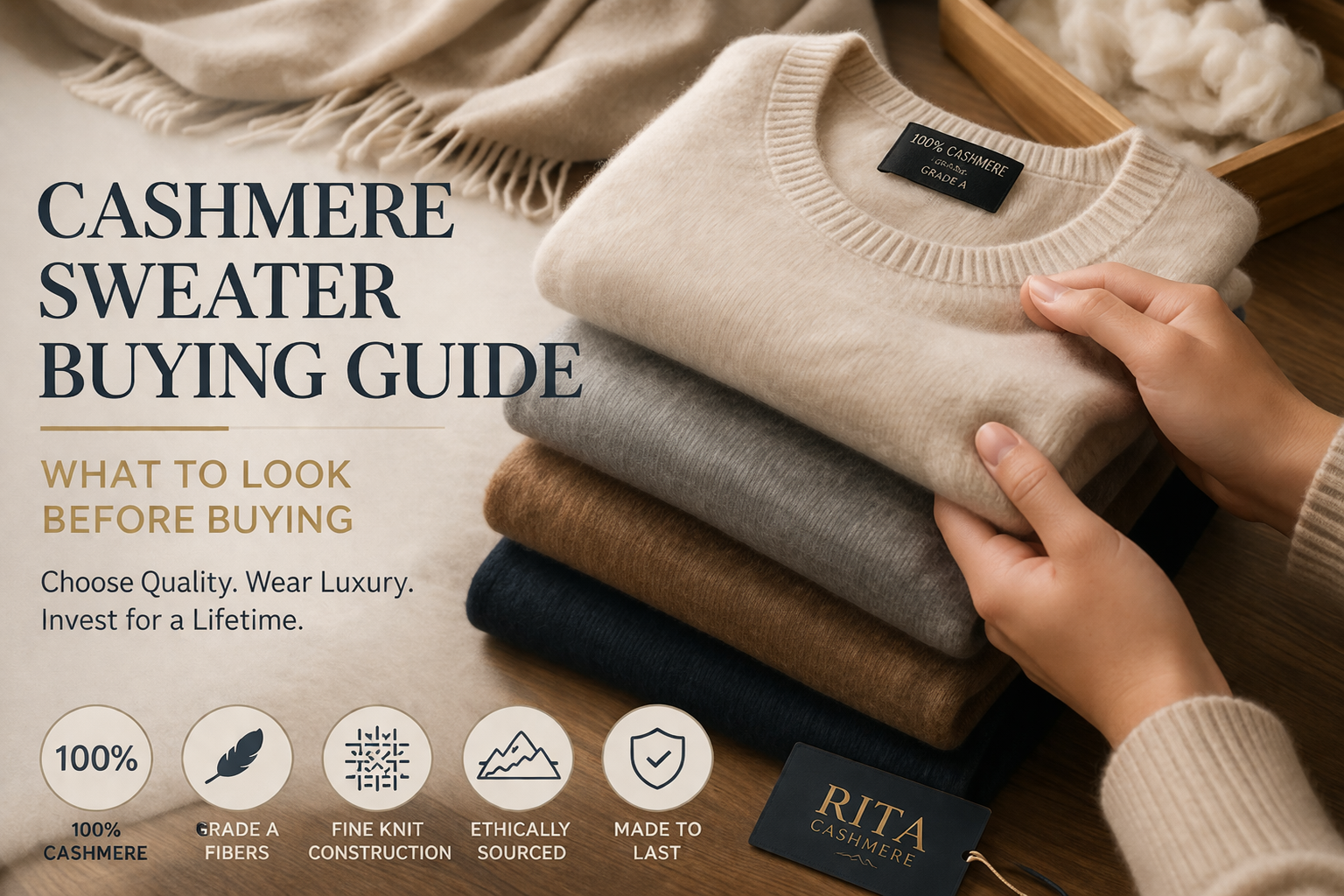
There’s nothing quite like slipping into a real cashmere sweater — that cloud-like softness, the gentle warmth, the effortless elegance. But with so many options flooding the market, knowing how to buy a cashmere sweater the right way can mean the difference between a garment that lasts a lifetime and one that pills after a single wash.
This cashmere quality guide is built for both individual buyers who want the best cashmere sweater for their wardrobe, and for brands and retailers looking for a trusted manufacturing partner. At Rita Cashmere, we’ve spent years crafting premium Himalayan cashmere garments — and we want you to shop (and source) smart.
1. Check the Grade of Cashmere
When learning how to buy a cashmere sweater, grade is the first thing to understand. Cashmere comes in three grades — and the difference is enormous.
Grade A cashmere features fibers measuring around 14–15.5 microns in diameter and at least 36mm in length. It’s the finest, softest, and most durable — the true standard for the best cashmere sweater you can own.
Grade B cashmere has slightly thicker fibers (16–19 microns). It may feel soft initially but tends to pill quickly and wear out faster.
Grade C is the lowest quality, commonly found in blended or budget products — often marketed deceptively as “pure cashmere.”
At Rita Cashmere, we exclusively use Grade A Himalayan cashmere, sourced from the soft underbelly of Changthangi goats raised in high-altitude pastures, ensuring every piece meets the highest standard of quality.
2. Real Cashmere vs Fake: How to Tell the Difference
One of the most searched questions in this space is real cashmere vs fake — and for good reason. The market is flooded with imitations.
Here’s how to spot the difference:
| Real Cashmere | Fake / Blended | |
|---|---|---|
| Label | 100% Cashmere | “Cashmere blend”, “cashmere-feel” |
| Touch | Immediately soft, no scratch | Rough, stiff, or plasticky |
| Weight | Light for its warmth | Heavy or flimsy |
| Burn test | Burns like hair, smells like burnt protein | Melts, smells synthetic |
| Pilling | Minimal over time | Heavy pilling within weeks |
| Price | Reflects genuine quality | Suspiciously cheap |
Terms to watch out for:
- “Cashmere-like” — synthetic imitation
- “Cashmere touch” — marketing language, not cashmere
- “Cashmere blend” — check the actual cashmere percentage; it may be as low as 10%
Always read the label. Reputable manufacturers clearly state 100% fiber composition. If it’s vague or missing — walk away.
3. Look at the Ply and Weight
Ply refers to the number of cashmere threads twisted together to form the yarn — and it directly affects warmth, structure, and feel.
- 1-ply — lightweight, ideal for layering or mild climates
- 2-ply — the most popular choice; perfect balance of warmth, softness, and durability
- 3-ply / 4-ply — heavier, thicker, ideal for colder winters or oversized styles
Thicker ply doesn’t always mean better quality, but it does determine how a sweater performs in your climate. Choose accordingly.
4. Do the Touch Test
Your hands are one of the best tools in this cashmere quality guide. When you pick up a sweater:
- It should feel immediately soft — not scratchy or rough
- It should feel light for its size
- It should carry a subtle natural warmth even before wearing
- Gently rub the fabric between your fingers — high-quality cashmere won’t aggressively shed or pill under light friction
If a sweater feels stiff, rough, or excessively fuzzy right off the rack, it’s a sign of low-grade fiber or a poorly processed blend.
5. Inspect the Knit and Construction
The way a sweater is constructed tells you a lot about how long it will last.
- Tight, even knit — hold it up to the light; the weave should be consistent with no gaps or loose threads
- Fully-fashioned construction — pieces are knitted to shape before being sewn together; look for neat seams at the shoulders and sides
- Cut-and-sew construction — panels cut from larger fabric; less precise and prone to unraveling
- Seamless knitting — the most premium method; minimal seams, smooth feel against skin
Check stitching at seams, cuffs, and collar. Loose threads, uneven stitching, or puckered seams indicate poor craftsmanship.
6. Understand Pilling — And What’s Normal
Pilling is one of the most misunderstood topics in any cashmere sweater buying guide. Here’s the truth: some pilling in the first few wears is completely normal, even with the best cashmere sweater you can buy. It’s caused by loose surface fibers settling — not a sign of poor quality.
What matters is what happens after. High-grade cashmere stabilizes and remains smooth with proper care. Low-grade cashmere pills aggressively and never stops.
Signs of pill-prone cashmere:
- Very fluffy or cloud-like surface before first wear
- Unusually loose, airy knit
- Price that seems too good to be true
Use a cashmere comb to gently remove any early pills — and they won’t return.
7. Consider the Origin of the Cashmere
Where your cashmere comes from matters deeply when evaluating cashmere quality.
- Himalayan cashmere — among the finest in the world; extreme cold produces extraordinarily fine, dense undercoats
- Mongolian cashmere — highly regarded for softness and consistent fiber quality
- Chinese cashmere — the world’s largest producer; quality varies widely from excellent to very low grade
- Scottish-processed cashmere — known for refined combing and spinning techniques
At Rita Cashmere, our raw fiber is sourced from the high-altitude pastures of the Himalayas — where the cold climate naturally produces some of the world’s finest cashmere fibers.
8. Assess the Color and Dye Quality
Color is more than aesthetics — it reflects the dyeing process and fiber integrity.
- Natural undyed cashmere (white, ivory, grey, light brown) is the purest form and retains the most fiber strength
- Well-dyed cashmere has rich, even, consistent color — no blotchiness or fading at seams
- Rub a damp white cloth on the sweater — heavy color transfer signals poor dye quality and future bleeding
- Overly bright or neon shades can require harsh chemical treatments that weaken fibers over time
9. Know the Right Price Range
The best cashmere sweater is never the cheapest one on the shelf — but a high price alone doesn’t guarantee quality either.
Genuine Grade A cashmere involves intensive sourcing, cleaning, combing, spinning, and expert knitting. That process has a real cost. Be especially cautious of “100% cashmere” products sold at fast-fashion prices — they almost always involve low-grade fiber, deceptive blending, or both.
Use price as one signal among many — not the only one.
10. Check the Care Instructions
Quality cashmere comes with honest, clear care guidance:
- Hand wash in cool water or dry clean — standard for pure cashmere
- Flat dry — never wring or hang, as this stretches the fibers
- Store folded — hanging causes cashmere to lose its shape over time
- Avoid direct sunlight and heat — both degrade cashmere fibers
A brand that provides thorough care instructions is a brand that stands behind the quality of its product.
🧶 Ready to experience Grade A Himalayan cashmere? Explore Rita Cashmere’s full collection — crafted for those who demand the best. [Shop the Collection]
For Brands & Wholesale Buyers: Partner With Rita Cashmere
If you’re a fashion brand, retailer, or buyer looking to source premium cashmere at scale — this section is for you.
Rita Cashmere is a full-service cashmere OEM manufacturer offering end-to-end production solutions for international brands. Here’s what we offer:
Private Label Manufacturing Launch your own cashmere line under your brand name. We handle everything — fiber sourcing, knitting, finishing, labeling, and packaging — to your exact specifications.
Custom Knitwear Development From technical design to production samples, we work closely with your design team to bring custom silhouettes, stitch patterns, and colorways to life.
Flexible MOQ (Minimum Order Quantities) We accommodate both emerging brands and large-scale retailers. Whether you’re launching your first cashmere capsule or expanding an existing line, we have a production tier that works for you.
Quality Assurance Every batch undergoes rigorous fiber testing, construction inspection, and finishing review before shipment. You receive Grade A cashmere — every time, at every quantity.
Why Rita Cashmere?
- Direct access to Himalayan fiber sources
- Transparent supply chain and ethical sourcing
- Experienced team with deep technical cashmere expertise
- Fast turnaround and reliable delivery timelines
📦 Interested in OEM or private label cashmere manufacturing?
Quick Buying Checklist
Before you purchase your next cashmere sweater, run through this list:
✅ Label reads 100% Cashmere
✅ Grade A fiber confirmed
✅ Himalayan or Mongolian origin
✅ Soft and light to the touch — no scratchiness
✅ Tight, even, consistent knit
✅ Well-constructed seams, no loose threads
✅ Rich, even color — no transfer on damp cloth
✅ Clear care instructions provided
✅ Price reflects genuine quality
✅ From a transparent, trusted manufacturer
Frequently Asked Questions (FAQ)
How can you tell if cashmere is high quality?
High-quality cashmere feels immediately soft and light, comes labeled as 100% Grade A cashmere, has a tight and even knit, and pills minimally over time. The burn test is also reliable — real cashmere burns like hair, smells like burnt protein, and leaves a crushable ash. Synthetic fibers melt and smell chemical.
Is expensive cashmere always better?
Not always — but very cheap “cashmere” is almost never the real deal. Genuine Grade A cashmere costs more to produce because the fiber is rare, labor-intensive to harvest, and requires expert processing. A fair price reflects that. However, heavy brand markup can inflate prices on lesser-quality products, so always cross-check with the other quality indicators in this guide.
How long should a cashmere sweater last?
A well-made, Grade A cashmere sweater can last 20–30 years or more with proper care — making it one of the most cost-effective wardrobe investments you can make. The key is gentle washing, correct storage (folded, not hung), and using a cashmere comb to manage any early pilling.
What is the difference between cashmere grades?
Grade A cashmere has the finest and longest fibers (14–15.5 microns, 36mm+), making it the softest and most durable. Grade B is slightly coarser and less refined, while Grade C is the lowest quality — often found in blended or budget garments. Rita Cashmere exclusively works with Grade A fiber.
What does OEM cashmere manufacturing mean?
OEM (Original Equipment Manufacturer) means we produce cashmere garments designed and branded by you. You provide the design, branding, and specifications — we handle the full production process using our Grade A Himalayan cashmere. It’s the ideal solution for fashion brands looking to launch or expand a premium knitwear line without building their own manufacturing infrastructure.
Final Thoughts
A great cashmere sweater is more than a purchase — it’s an investment in comfort, craftsmanship, and longevity. When you know how to buy a cashmere sweater the right way, you stop settling for blends and imitations, and you start owning pieces that truly last.
At Rita Cashmere, every garment we make reflects our commitment to authentic Grade A fiber, ethical Himalayan sourcing, and uncompromising quality — whether you’re a first-time buyer or a global fashion brand.
Shop with knowledge. Source with confidence. Choose Rita Cashmere.
🧶 Individual Buyers: [Explore Our Collection]
📦 Brands & Wholesalers: [Request an OEM Quote]
Rita Cashmere — Premium Himalayan Cashmere, Crafted to Last.