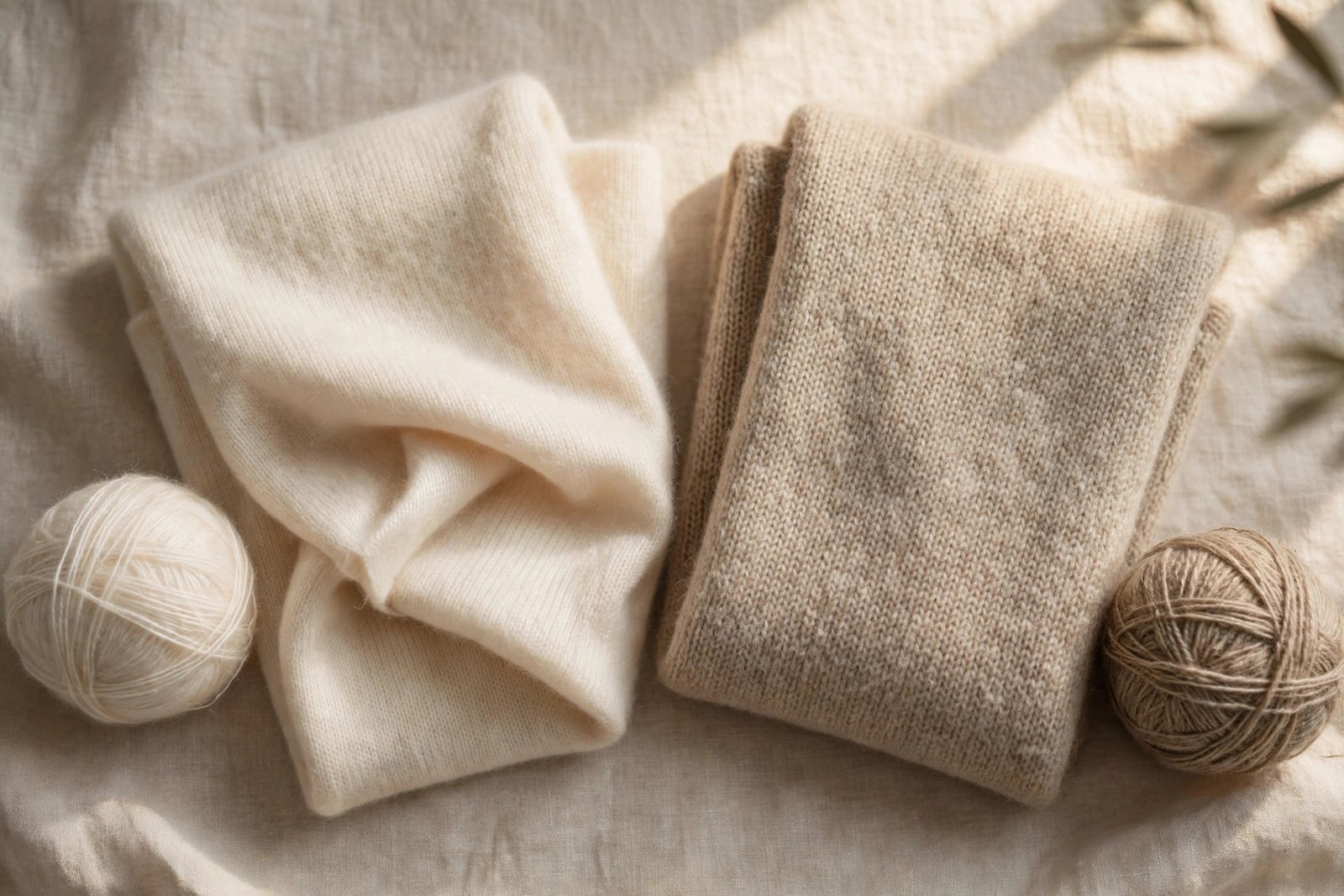
Cashmere is warmer for its weight and softer against the skin. Merino wool is tougher, easier to care for, and costs less. That is the short answer to cashmere vs merino wool. A cashmere sweater is for cold, quiet days when comfort matters most. A merino sweater is for every day: wash without worry, pack for a trip. This guide compares them the way a knitwear maker sees them. In short, cashmere vs merino wool is a choice between comfort and toughness.
Cashmere vs Merino Wool at a Glance
| Feature | Cashmere | Merino Wool |
|---|---|---|
| Warmth | Excellent for its weight; warmer per gram | Excellent; steady warmth across changing conditions |
| Softness | Exceptionally soft, silky hand feel | Very soft for wool; slightly springier feel |
| Durability | Delicate; needs gentle handling | More resilient; forgiving in daily wear |
| Care | Hand wash cold, dry flat | Many garments machine washable on a gentle cycle (check the label) |
| Price | Premium; limited supply, hand-combed fibre | Broad range; produced at much larger scale |
| Best uses | Luxury sweaters, scarves, shawls, gifts | Base layers, everyday sweaters, travel, outdoor wear |
Neither fibre wins every row.
What Is Cashmere?
Cashmere is the soft undercoat of the cashmere goat, gathered once a year by hand-combing during the spring moult. Each goat yields only around 80 to 170 grams a year, so one sweater can take several goats’ yield. That scarcity is the first reason cashmere costs more.
Standard cashmere generally measures 18 to 21 microns. Chyangra pashmina, the Himalayan cashmere we knit with at Rita Cashmere, is finer at 12 to 16 microns, hand-combed above 14,000 feet and certified by the Nepal Pashmina Industries Association (NPIA). Finer fibre bends against the skin instead of pressing into it, so good cashmere almost never itches (see what is cashmere). That fineness is why cashmere vs merino wool comparisons start with microns.
What Is Merino Wool?
Merino wool comes from Merino sheep, bred over centuries for exceptionally fine fleece. Apparel-grade merino generally measures 15 to 24 microns, far softer than ordinary wool and comfortable next to the skin. It is the fibre behind base layers, hiking socks, and travel sweaters. The big difference is scale: merino is shorn from millions of sheep in many grades and price points, so it shows up everywhere from budget sweaters to technical wear, while cashmere stays premium.
See how merino sits within the wider wool family in our wool fabric guide. That scale difference shapes every cashmere vs merino wool choice.
Cashmere vs Merino Wool Warmth: What Is Warmer?
What is warmer, cashmere or merino wool? Per gram, cashmere: a light cashmere sweater can keep you as warm as a noticeably heavier merino one, because its finer fibres trap more still air for the same weight. That warmth-to-weight advantage is why cashmere shawls feel almost weightless in deep winter. That is the cashmere vs merino wool warmth question in one sentence.
But compare like with like. A thick, chunky merino sweater will be warmer than a fine, sheer cashmere one, because knit gauge changes everything. On our flat knitting machines, a 12GG fine-gauge cashmere knit and a 5GG chunky merino knit are built for different jobs. So when people ask “is cashmere warmer than merino wool” or “is merino wool or cashmere warmer,” the honest answer is this: cashmere wins on warmth per weight, merino wins on steady, adaptable warmth across a day of changing temperatures and activity.
Which Is Softer: Cashmere or Merino Wool?
Cashmere, and it is not a close contest at the top end. Chyangra pashmina at 12 to 16 microns has a smooth, silky hand feel that no wool quite matches. It drapes against the neck and wrists with almost no resistance, which is why cashmere dominates scarves and shawls. That silky feel is the headline in any cashmere vs merino wool comparison.
Merino deserves more credit than it usually gets. Fine merino at 15 to 19 microns is genuinely soft, and most people wear it next to the skin without irritation. It feels springier, with a little more texture and body. The itch line sits at around 30 microns: above it, fibres press into the skin and trigger prickle. Both fine cashmere and fine merino sit well below it. The difference is that cashmere feels like nothing at all, while merino feels like something soft.
Durability and Pilling: Where Merino Wins
Here is where honesty favours merino. Cashmere’s very fine fibres are delicate by nature. Friction at elbows, underarms, and under a bag strap wears the surface and raises pills, small balls of tangled fibre. Good cashmere pills less, and pills can be combed away. But the fibre itself will never be as abrasion-resistant as wool.
Merino is built for harder use. Its fibres are springier, they recover their shape, and they handle repeated wear and washing with far less fuss. That is why merino is the standard for base layers, socks, and travel knitwear. Durability is not only about fibre, though. Long-staple fibres, two-ply yarn, and a sound knit extend the life of a garment in either fibre. Cheap short-fibre cashmere pills within weeks. Long Grade A cashmere, cared for properly, lasts for years. That resilience is the strongest case for merino in cashmere vs merino wool.
Care Compared: What Each Fibre Asks of You
| Care point | Cashmere | Merino Wool |
|---|---|---|
| Washing | Hand wash in cold water with a mild detergent | Many garments machine washable on a gentle or wool cycle |
| Drying | Always dry flat, away from direct heat | Dry flat is safest |
| Frequency | Wash rarely; air between wears | Can go longer between washes; merino resists odour |
| Pilling | Comb pills away; they lessen with wear | Pills less; comb if needed |
That care difference is a practical part of cashmere vs merino wool.
Price and Value
Cashmere costs more for practical reasons, not snobbery. The fibre is scarce, each goat yields very little, collection is hand-combing rather than shearing, and dehairing, separating fine down from coarser guard hair, is slow and skilled work. Merino is produced at a far larger scale in a far wider range of grades, so prices run from affordable to premium.
Value is a different question from price. A quality cashmere sweater, bought well and cared for, can be a ten-year piece, while a cheap one that pills in a month is money wasted. Merino gives more durability per dollar for everyday wear. Cashmere gives more comfort per gram for the pieces you love most. Our guide on why cashmere costs more breaks the cost down in full. That is the value question at the heart of cashmere vs merino wool.
Mongolian Cashmere vs Merino Wool
Mongolian cashmere vs merino wool comes up often, so here is the straight answer. Mongolia produces a large share of the world’s cashmere fibre, but a label name tells you origin, not fineness. Mongolian cashmere spans many grades. The best of it is excellent. Lower grades, with coarser or shorter fibres, feel less soft and pill more quickly.
Chyangra pashmina is the Himalayan answer. It comes from goats herded above 14,000 feet in Nepal’s Mustang, Dolpa, Humla, Jumla, and Manang regions, measures 12 to 16 microns, and carries NPIA certification with a hallmark label. When you compare Mongolian cashmere vs merino wool, compare grade against grade, not country against fibre. Fine, long-staple cashmere from any origin will out-soften merino. Coarse, short-fibre cashmere will not.
Cashmere or Merino Wool: Which Should You Choose?
The cashmere vs merino wool decision comes down to the job, not the price tag.
| If your priority is | Choose |
|---|---|
| Luxury softness next to the skin | Cashmere |
| Lightweight warmth for cold days | Cashmere |
| Scarves, shawls, and gifts | Cashmere |
| Everyday sweaters worn hard | Merino |
| Base layers and active wear | Merino |
| Travel and odour resistance | Merino |
| Easy washing and low maintenance | Merino |
| A wardrobe that covers everything | Both, for different pieces |
For brands, the split is the same: cashmere carries the premium tier, merino the performance and everyday tier.
A Knitwear Maker’s Buying Checklist
Before you buy, or commission a production run, check these five things for any cashmere vs merino wool purchase.
- Micron count. Ask for it. Chyangra pashmina at 12 to 16 microns and fine merino at 15 to 19 microns are the numbers that deliver next-to-skin comfort.
- Ply. Two-ply yarn beats single-ply in both fibres: less pilling, better shape.
- Gauge and density. Hold the garment up to the light. A quality knit looks even and dense for its gauge, with no thin spots. A fine 12GG knit should feel smooth and consistent, while a chunky 5GG knit should feel springy and full.
- Fibre length. Long-staple fibre pills less and lasts longer. This is the single biggest difference between quality cashmere and cheap cashmere, and it is invisible until the garment has been worn a few times.
- A sample first. For brands ordering knitwear, always approve a physical sample before production. Feel the hand, check the gauge against your design, and wash-test it once.
Cashmere vs Merino Wool FAQs
What is warmer, cashmere or merino wool?
Cashmere, by weight: its finer fibres trap more air and insulate more per gram. A heavy merino sweater can still beat a very thin cashmere one, so compare similar weights and gauges.
Is cashmere better than merino wool?
It depends on what you need. Cashmere is better for softness, lightweight warmth, and luxury knitwear. Merino is better for durability, moisture management, odour resistance, and active wear. That trade-off defines cashmere vs merino wool for most buyers.
Does cashmere pill more than merino wool?
Generally, yes. Cashmere’s fine fibres pill more in high-friction areas such as elbows and underarms. Pills can be combed away, and long-staple two-ply cashmere pills far less than short-fibre cashmere.
Can you machine wash merino wool?
Many merino garments are machine washable on a gentle or wool cycle, but not all, so check the care label first. Cashmere needs hand washing in cold water, dried flat.
Mongolian cashmere vs merino wool: which should I buy?
Compare grade, not origin. Fine, long-staple cashmere from any origin feels softer and warmer per gram than merino. Coarse cashmere does not. For certified fineness, Chyangra pashmina at 12 to 16 microns is a known quantity. For hard-wearing everyday knitwear, merino is the safer buy.
The Short Version
Cashmere vs merino wool has no single winner. Cashmere gives you the softest, warmest-for-its-weight knitwear you can buy, and asks for gentle care and a higher price in return. Merino gives you the hardest-working everyday knitwear: easy to wash, hard to wear out. The best wardrobes use both, each where it belongs.
Rita Cashmere is a knitwear manufacturer in Kathmandu, Nepal, working in NPIA-certified Chyangra pashmina since 2013, and we also knit wool ranges for brands that want both tiers in one collection. For the wider comparison, read our cashmere vs wool guide.