
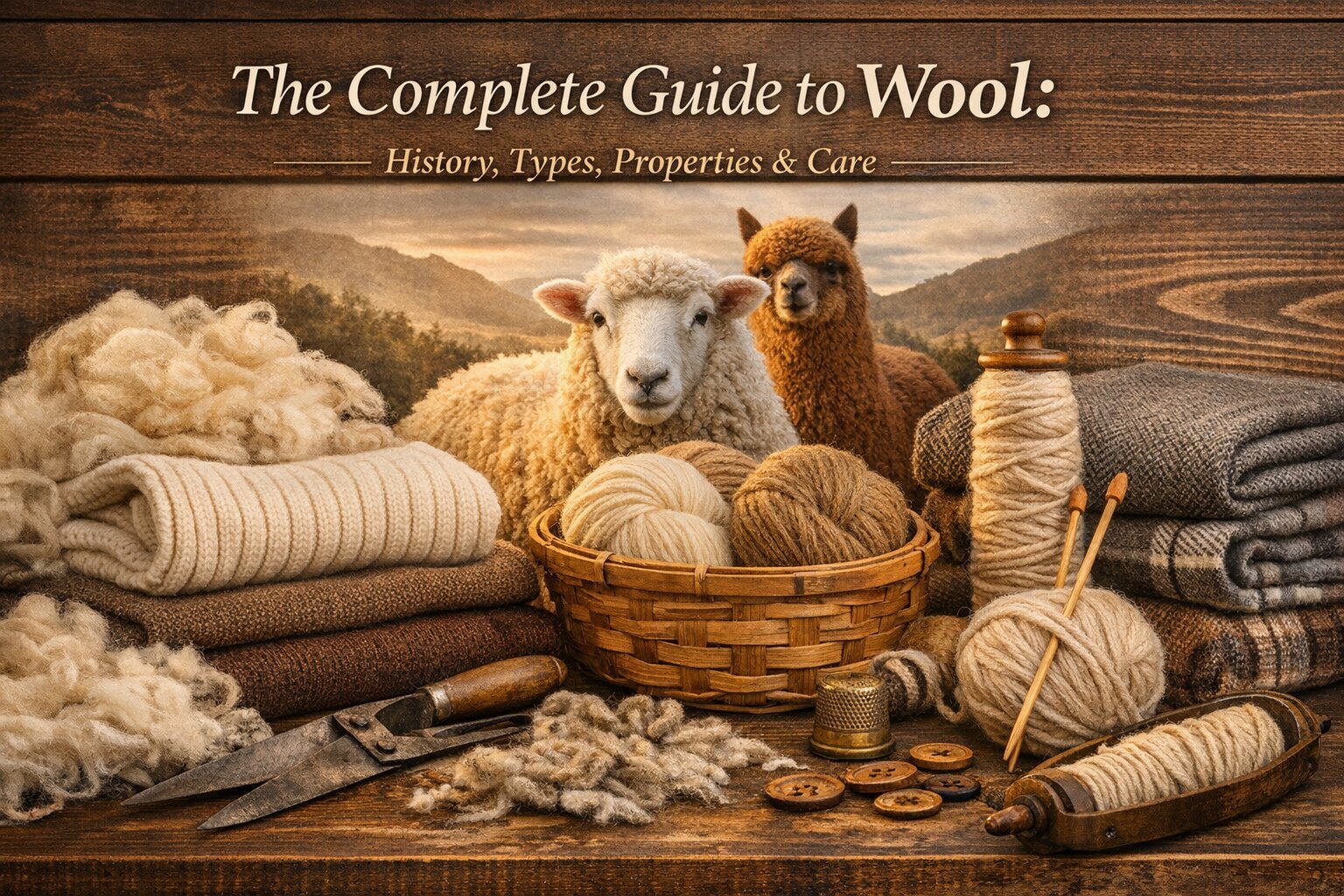
Few materials in human history have endured as long, or served as faithfully, as wool. Long before synthetic fibers existed, wool clothing was the answer to cold winters, rugged terrains, and the simple human need to stay warm. From the high plateaus of ancient Iran to the vast grazing lands of modern Australia, this remarkable natural wool fabric has traveled with civilization itself.
Today, wool is no longer just a survival material. It is a considered choice — one made by people who understand what natural fiber can do that synthetics simply cannot. It breathes. It regulates temperature. It resists flame. It biodegrades. And depending on the animal it comes from, it can range from remarkably rugged to extraordinarily fine.
At Rita Cashmere, wool forms the foundation of our natural fiber philosophy. While cashmere and pashmina occupy their own extraordinary categories, wool in its broader sense deserves its own deep exploration. This guide covers everything — what wool is, how it is made, the full spectrum of wool types, its properties, its environmental impact, and how to care for it properly.
Whether you are a first-time wool buyer or someone building a considered wardrobe, this is the only wool guide you will need.
What Is Wool Fabric?
Wool is a natural textile fiber harvested from the fleece of animals — most commonly sheep, but also goats, alpacas, camels, rabbits, and other fiber-bearing mammals. Unlike plant-based fibers such as cotton or linen, wool is protein-based, making natural wool fabric fundamentally different in structure and behavior from anything grown in a field or synthesized in a laboratory.
Its structure is made primarily of keratin, the same protein found in human hair and nails, along with a small percentage of lipids. This protein structure is what gives wool its remarkable range of properties. Keratin fibers are naturally elastic, flame-resistant, moisture-wicking, and thermally insulating. These are not treatments or finishes applied in a factory — they are intrinsic to the fiber itself.
At a microscopic level, wool fibers are covered in tiny overlapping scales, similar to the shingles on a roof. These scales allow wool to trap air between fibers, creating an insulating layer that keeps warmth in during cold conditions and helps regulate temperature during warmer ones. The natural waviness of wool fibers — known as crimp — further enhances this air-trapping ability. More crimp means more insulation.
Wool is also hygroscopic, meaning it can absorb moisture vapor from the surrounding air without feeling wet. It can absorb up to 30 percent of its own weight in moisture before it begins to feel damp. This makes it remarkably comfortable to wear during physical activity or in variable weather conditions.
A Brief History of Wool
The Stone Age and Ancient Origins
The story of wool begins approximately 10,000 years ago, during the Neolithic period. Early humans in the region that is now Iran and Central Asia began domesticating sheep not originally for their woolly fleeces — wild sheep are actually quite hairy — but for their meat and milk. Over thousands of years of selective breeding, these early farmers gradually developed woolier animals whose fleeces were far more suited to spinning and weaving.
The earliest confirmed evidence of woven wool garments dates to around 4000 BC. By approximately 3500 BC, Mesopotamian civilizations were trading wool textiles, and the material had become one of the first globally traded commodities.
Wool in the Ancient and Classical World
By the time of the Roman Empire, wool production was a pillar of the economy. Roman soldiers wore woolen cloaks and tunics across northern Europe, and the empire actively managed wool trade routes across the Mediterranean. When Roman legions pushed into Britain and other northern territories, they found local peoples who had independently developed sophisticated wool traditions of their own.
In medieval Europe, wool became even more central. By the 12th and 13th centuries, English wool was considered among the finest in the known world, and the wool trade drove the economies of England, Flanders, and Italy. The famous Medici family of Florence built much of their early fortune on wool — not banking, as is often assumed, but the cloth trade. The word “sterling” itself is thought by some historians to be linked to the Hanse merchants and their wool trade networks.
The Industrial Revolution and Modern Wool
The invention of the spinning jenny, the power loom, and other mechanical advances in the 18th century transformed wool production from a cottage industry into a global manufacturing sector. Mills in Yorkshire, England became the beating heart of the world wool trade.
The colonization of Australia brought a transformative development. When British settlers introduced merino sheep to the Australian continent in the late 18th century, they could not have predicted what followed. The vast open grasslands proved ideal grazing territory, and within decades Australia had become the world’s dominant wool producer — a position it holds to this day.
Wool in the Modern Era
The 20th century brought challenges. The rise of synthetic fibers — nylon in the 1930s, polyester in the 1950s, and a wave of new materials in the decades that followed — sharply reduced global wool consumption. Wool’s share of the apparel fiber market fell from around 10 percent in the 1960s to under 2 percent by the 2000s.
But wool has never disappeared. Its unique properties cannot be replicated by synthetics, and in recent decades a renewed appreciation for natural, sustainable fibers has brought wool back into serious consideration. Innovations in processing — machine-washable merino, odor-resistant performance wool, ultrafine superfine grades — have made wool relevant again for everything from athletic wear to luxury suiting.
How Is Wool Made? The Production Process
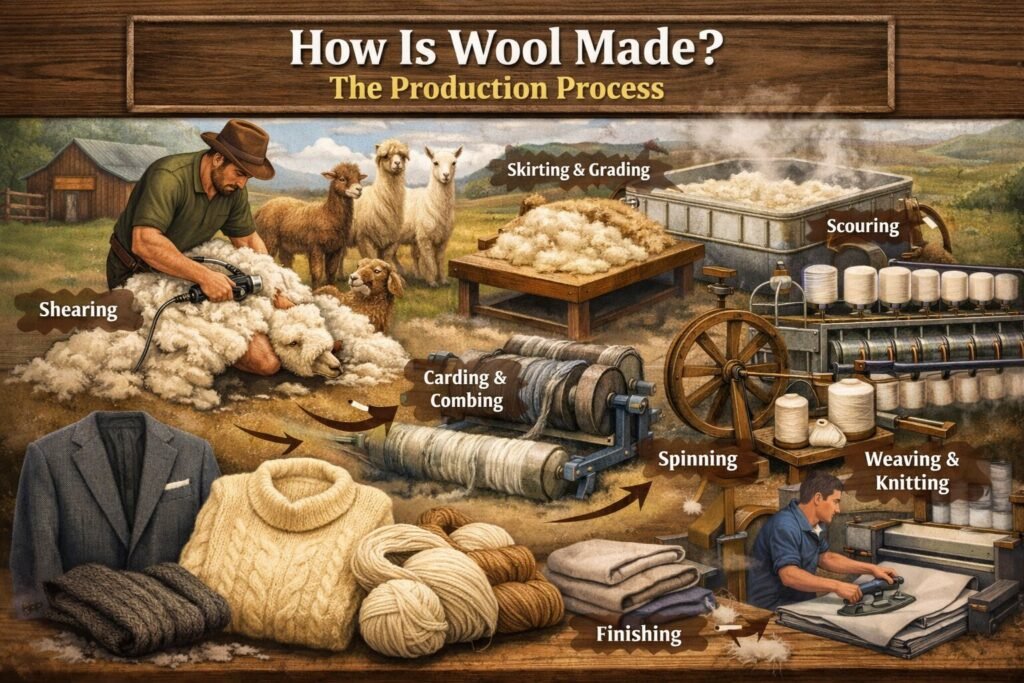
Understanding how wool moves from an animal’s back to a finished garment illuminates why quality varies so much between products — and why the finest wools command the prices they do.
1. Shearing
The process begins with shearing — the removal of the animal’s fleece, typically once a year in spring. Skilled shearers can remove an entire fleece in a single piece in under five minutes. The timing of shearing is important: done too late in spring and the wool can begin to break naturally; done under stress, it can affect fiber quality.
A single merino sheep typically yields between 4 and 5 kilograms of raw fleece per year. Alpacas yield between 2 and 4 kilograms. Cashmere goats, by contrast, produce only around 150 grams of the fine undercoat fiber used in cashmere production — which is one reason cashmere sits in its own pricing tier.
2. Skirting and Grading
Once sheared, the fleece is skirted — the edges, which tend to contain more vegetable matter and lower-quality fiber, are removed. What remains is then graded according to fineness (measured in microns), staple length, strength, color, and vegetable matter content. This grading determines end use: the finest grades go to luxury apparel, coarser grades to carpets or industrial uses.
3. Scouring
Raw wool is full of lanolin (the natural grease secreted by sheep’s skin), along with sweat, dirt, and vegetable matter. Scouring is the washing process that removes all of this. Large wool scouring operations run the fleece through a series of hot water baths with detergent, removing impurities while preserving the fiber structure. The recovered lanolin is itself a valuable byproduct, used in cosmetics and pharmaceuticals.
4. Carding and Combing
After scouring, the clean fibers are carded — passed through fine-toothed rollers that disentangle and align them into a continuous web. This web is then condensed into a soft rope of fiber called a sliver.
For high-quality worsted wool (the smoother, denser type used in suits and fine fabrics), the sliver undergoes an additional combing process that removes short fibers and aligns the remaining long fibers parallel to each other. This produces a much smoother, stronger, and more lustrous yarn than woolen-spun alternatives.
5. Spinning
The sliver is drawn out and twisted into yarn. The tightness of the twist, the thickness of the yarn, and the number of plies all affect the final fabric’s character. Tightly twisted yarns produce crisp, smooth fabrics; loosely twisted yarns produce softer, more textured ones.
6. Weaving or Knitting
Wool yarn is either woven into fabric on a loom or knitted into fabric on a knitting machine. Woven wool fabrics include suiting cloths, tweeds, and gabardine. Knitted wool fabrics include jersey, interlock, and the structure used in most sweaters and knitwear.
7. Finishing
After weaving or knitting, wool fabric goes through a series of finishing processes. Fulling involves controlled agitation in warm water, causing the fibers to slightly felt together and produce a denser, more cohesive fabric. Milling, pressing, raising (brushing up a nap), and shearing (not of animals, but of the fabric surface) are among the many finishing treatments that give different wool fabrics their distinct textures and appearances.
The Key Properties of Natural Wool Fabric: Wool Material Benefits Explained
Thermal Regulation
Wool’s most celebrated property is its ability to keep the wearer warm — but this is only half the story. Wool is genuinely thermoregulating, meaning it responds to conditions rather than simply insulating. The crimp structure creates air pockets that trap warmth when it is cold, while wool’s moisture management keeps the skin dry during activity, preventing the chilling effect of sweat-soaked fabric. This is why wool works in a wide range of temperatures and is a foundation material in military and outdoor wool clothing worldwide.
Moisture Management
Wool can absorb up to 30 percent of its weight in moisture vapor without feeling wet to the touch. It achieves this through a two-part fiber structure: the outer scales are hydrophobic (they repel liquid water), while the inner core is hydrophilic (it absorbs moisture vapor). This combination means that wool pulls perspiration away from the skin in vapor form before it becomes liquid, keeping the wearer comfortable during activity. When the fiber eventually becomes saturated, it releases heat through a process called heat of sorption — which actually generates a small amount of warmth as moisture is absorbed.
Flame Resistance
Wool is naturally flame-resistant to a degree that no synthetic fiber can match without chemical treatment. Its high protein content and high moisture content mean it requires significantly higher temperatures to ignite than cotton or synthetic fibers. When it does burn, it chars rather than melts, does not drip burning particles, and self-extinguishes when the flame source is removed. This is why wool is standard in firefighter garments, aircraft seating, and other safety-critical applications.
Odor Resistance
Wool’s microscopic scale structure and its ability to manage moisture both contribute to natural odor resistance. The scales trap odor-causing bacteria on the surface of the fiber rather than allowing them to penetrate — and when wool is aired or washed, these bacteria are released. Merino wool in particular is prized for its ability to be worn multiple times between washes without developing odor, making it ideal for travel and outdoor use.
Durability and Elasticity
A single wool fiber can be bent back and forth more than 20,000 times before breaking — cotton breaks after around 3,000 bends, and silk after approximately 1,800. Wool also returns to its original shape after stretching, thanks to the coiled, spring-like molecular structure of keratin. This resilience means that well-made wool garments do not simply age — they develop character.
UV Protection
Wool naturally absorbs ultraviolet radiation, providing a degree of sun protection that varies by fabric weight and construction. This UV-absorbing property comes from the amino acids in wool’s protein structure.
Biodegradability
Unlike polyester, nylon, or acrylic — which can persist in landfill for hundreds of years — wool biodegrades naturally. In soil, a wool fiber can decompose fully within months to a few years, releasing nitrogen and other nutrients back into the earth.
Types of Wool Fabric: A Complete Overview
The word “wool” encompasses a surprisingly wide family of fibers, each with distinct characteristics, appropriate applications, and price points. What unites them is their protein-based, keratin structure and their origin from fiber-bearing animals.
Merino Wool
Merino is the gold standard of sheep wool and the variety most people encounter in quality wool clothing today. Originally bred in Spain, merino sheep are now predominantly raised in Australia and New Zealand, and Australian merino wool is considered the benchmark for the global market.
What distinguishes merino is its extraordinary fineness. While standard wool fibers measure 30 microns or more in diameter, merino ranges from 15 to 24 microns. Superfine merino falls below 18 microns, and ultrafine grades can reach 12 microns or below. At these diameters, the fibers are too fine to trigger the prickling sensation that coarser wool causes against skin — making merino genuinely comfortable for direct wear.
Its combination of softness, thermal regulation, and odor resistance has made merino the dominant natural wool fabric in outdoor and athletic wool clothing worldwide.
Standard Sheep Wool (Lambswool and Fleece Wool)
Lambswool refers specifically to the first shearing of a young sheep, typically at around seven months old. Because the fiber has never been cut before, its tips are naturally tapered rather than blunt, giving lambswool a particularly soft, fine handle. Virgin wool — a related term — refers to wool that has not been recycled or reprocessed from existing wool products.
Standard fleece wool from mature sheep is coarser than merino or lambswool, typically measuring 25 to 35 microns, and is used in outerwear, blankets, carpets, and industrial textiles. It is robust, warm, and highly durable.
Shetland Wool
Shetland wool comes from the small, hardy Shetland sheep native to the Shetland Islands of Scotland. It is finer than standard sheep wool but coarser than merino, typically measuring 23 to 28 microns. Shetland wool has a distinctive character — slightly springy, with a natural color range from cream to dark brown and grey — and is the traditional fiber for Fair Isle and other northern knitting traditions.
Alpaca Wool
Alpacas are camelids native to the high Andes of South America, where they have been domesticated for their fiber for at least 6,000 years. Alpaca fiber is exceptionally fine, soft, and warm — and critically, it contains no lanolin, making it naturally hypoallergenic. This absence of lanolin also means it does not have the slightly waxy feel of unwashed sheep wool.
There are two breeds used for fiber production. Huacaya alpacas produce a crimped, fluffy fiber that is most commonly used in knitwear and soft apparel. Suri alpacas produce a longer, lustrous, silky fiber with little crimp that is used in fine woven fabrics and blends. Baby alpaca — a grading term, not an age category — refers to the finest fibers sorted from an adult alpaca’s fleece, typically measuring 18 to 22 microns.
Mohair
Mohair comes from the Angora goat — not to be confused with the Angora rabbit. It is characterized by its high luster, silky texture, and exceptional strength. Mohair has a natural sheen that increases with the age of the animal; the finest kid mohair, from young animals, is soft enough for use next to skin, while adult mohair is typically used in pile fabrics, rugs, and upholstery.
Mohair has faced significant ethical scrutiny following investigations into conditions on some mohair farms, and many brands have moved toward certified sources or discontinued its use entirely. Ethically sourced mohair from certified producers remains available and continues to be valued for its unique properties.
Vicuña
The vicuña is a wild camelid native to the high Andes, closely related to the alpaca. Its fiber is the finest and rarest natural textile in the world, with diameters between 6 and 13 microns. For centuries, the vicuña was hunted to near-extinction for its fiber; today it is a protected species under Peruvian law, and fiber can only be harvested through licensed, community-managed round-ups that do not harm the animals.
The rarity, fineness, and warmth-to-weight ratio of vicuña fiber place it at the absolute summit of natural textile pricing. It is worth noting that vicuña sits in a different tier from wool in the conventional sense — closer to cashmere or pashmina in its luxury positioning.
Camel Hair
Camel hair is harvested primarily from the Bactrian camel of Central Asia and Mongolia. The soft undercoat — which the camel naturally molts in spring — is collected by hand and separated from the coarser outer guard hair. The fine undercoat is exceptionally lightweight and insulating, with a natural tawny-gold color that is typically left undyed. Camel hair coats were a luxury staple in the early 20th century and remain prized for their warmth-to-weight ratio and distinctive coloring.
Angora Wool
Angora wool comes from the Angora rabbit, not the Angora goat. Angora fiber is extraordinarily fine and soft, with a characteristic halo of fluffy fibers. It is very warm for its weight but also prone to shedding and matting, which is why it is usually blended with other fibers such as merino or silk for structural stability. Angora production has faced welfare scrutiny, and sourcing from certified humane producers is important for conscious buyers.
Yak Wool
Yak wool is harvested from the domestic yak, raised across the high-altitude plateaus of the Himalayas, Tibet, Mongolia, and Central Asia. The fine undercoat — separated from the coarser outer hair — is soft, warm, and naturally free from lanolin, making it hypoallergenic in a similar way to alpaca. Yak fiber typically measures between 16 and 20 microns, placing it in the same softness range as fine merino.
What makes yak wool genuinely distinctive is its insulating performance at altitude. The yak evolved to survive at elevations above 4,000 meters where temperatures routinely fall well below freezing, and its fiber reflects this. Yak wool is hollow at the core, trapping air exceptionally well and providing warmth-to-weight performance that rivals or exceeds most other natural fibers. It is also naturally moisture-wicking and odor-resistant, and its color range — from deep chocolate brown to silver-grey to cream — gives it an earthy, natural aesthetic that requires little or no dyeing.
In Nepal and Tibet, yak wool has been used for centuries in blankets, ropes, and traditional garments. As global interest in Himalayan natural fibers has grown, yak wool has moved into premium apparel and home textiles, where its combination of performance and provenance makes it one of the most compelling natural wool fabric stories available.
Qiviut
Qiviut is the fine undercoat of the musk ox, native to the Arctic regions of Alaska and Canada. At 15 to 19 microns, it is finer and softer than merino, and it is among the warmest natural fibers on earth — reportedly eight times warmer than sheep wool of the same weight. Qiviut does not felt, making it exceptionally stable. It is extremely rare and correspondingly expensive, produced in very small quantities by indigenous communities in Alaska.
How to Read Wool Quality: Microns, Grades, and What They Mean
The single most useful measure of wool quality is fiber diameter, expressed in microns (one micron = one millionth of a meter). Finer fibers are softer and less likely to cause skin irritation.
Below 17.5 microns — Ultrafine merino. The finest category of commercially available sheep wool. Used in the most luxurious knitwear and performance base layers.
17.5 to 19.5 microns — Superfine merino. Still exceptionally fine, soft against skin, used in premium knitwear and shirting.
19.5 to 22.5 microns — Fine merino. Excellent for knitwear, base layers, and casual wool garments worn next to skin.
22.5 to 24.5 microns — Medium merino. Suitable for garments with a lining layer or worn over a base layer.
Above 25 microns — Broader wool. Typically used in outerwear, blankets, rugs, and textiles where softness against skin is less critical.
A general rule: if you have sensitive skin, look for wools under 20 microns for anything worn directly against the body.
Wool Fabric Types and Weave Structures
The same fiber can produce very different fabrics depending on how it is spun and woven. Understanding these distinctions helps in choosing the right types of wool fabric for the right application.
Worsted wool is made from long, combed fibers that are aligned parallel before spinning. This produces a smooth, dense, hard-wearing fabric with a clean surface and good drape. Suits, trousers, blazers, and fine dress coats are typically made from worsted wool. Gabardine, serge, and cavalry twill are all worsted weaves.
Woolen cloth is made from shorter, carded fibers that are not aligned before spinning. This produces a softer, more textured, slightly fuzzy fabric with excellent insulation. Tweed, flannel, blanket cloth, and most knitwear are made from woolen-spun yarn.
Tweed is a rough-textured woolen cloth, traditionally woven in Scotland and Ireland. Harris Tweed — made on the Outer Hebrides from pure virgin wool — carries protected geographical indication status. Tweed is warm, durable, and resistant to wind and rain.
Flannel is a softly woven, slightly napped woolen or worsted cloth. It is the fabric of classic suiting for cooler months and traditional shirts.
Jersey is a knitted wool fabric — smooth on the face, with visible loops on the reverse. It is stretchy, comfortable, and used in everything from casual knitwear to tailored jackets.
Felt is a non-woven fabric produced by controlled felting — the matting together of wool fibers through heat, moisture, and pressure. Because it does not fray when cut, felt is used in everything from craft projects to industrial applications and traditional Mongolian yurt coverings.
Bouclé is a looped or knotted yarn woven into a textured fabric with a characteristic bumpy, curly surface. It is particularly associated with the aesthetic of 1960s Chanel-style suiting.
Where Is Wool Produced? The Global Landscape
Australia remains the world’s largest wool producer, responsible for approximately 25 percent of global supply. Its clip is dominated by merino wool, and Australian merino is the benchmark for quality used by wool buyers worldwide.
China is both the second-largest producer, at around 18 percent of global supply, and by far the world’s largest wool processor — a large proportion of the world’s raw wool is scoured, carded, and spun in Chinese mills regardless of where it was grown.
New Zealand produces approximately 11 percent of global wool, with a tradition of both fine merino and stronger crossbred wool varieties. Its wool is noted for its consistent quality and strong traceability standards.
Nepal occupies a unique position in the global wool map — not as a volume producer, but as a center of artisan craftsmanship. The Himalayan region has a centuries-old tradition of working with the wool of animals that live at high altitude — yak, sheep, and the fiber-bearing animals of the surrounding plateau. This tradition of handcraft, combined with the exceptional fiber available in the region, is what makes Nepali wool textiles distinct from anything produced industrially.
Other significant producers include the United States, Argentina, Uruguay, South Africa, and the United Kingdom. Each region has its own distinct wool traditions and breeds, contributing to the remarkable diversity of the global wool supply.
Wool and Sustainability: The Honest Picture
Wool is inherently more sustainable than most synthetic alternatives, but this does not mean it is without environmental and ethical considerations. Understanding both sides of this picture is important for any conscious buyer.
The Case for Wool
Wool is a renewable resource. Sheep and other fiber-bearing animals produce a new fleece every year without needing to be harmed, and quality breeding programs can continue to improve fiber quality over generations. The fiber itself is biodegradable — a wool garment at the end of its life will break down in soil, releasing nitrogen and sulfur as nutrients. By contrast, a polyester garment will shed microplastic particles throughout its life and persist in landfill for centuries.
Wool production, when done well, has a low energy footprint compared to most synthetic textiles. Growing the fiber requires sunlight, grass, and water — inputs that are part of natural cycles. The life cycle of a good wool garment, which may be worn for decades, has an extremely low per-wear environmental cost compared to fast fashion alternatives.
The Challenges
Land degradation is a real concern in some wool-producing regions. Overgrazing causes soil erosion, loss of native vegetation, and reduced water retention. Responsible land management is critical, and the best wool producers operate with explicit land stewardship programs.
Water use in scouring, dyeing, and finishing wool is significant, and chemical effluents from these processes need careful management. Many modern processing operations have invested in water recycling and responsible effluent treatment, but this is not universal.
Animal welfare concerns have been raised about certain practices in the industry. Mulesing — the removal of skin folds around the hindquarters of some merino sheep to prevent flystrike — has been a particular point of controversy. An increasing proportion of Australian merino production is now non-mulesed, and certification programs verify this.
Certifications to Look For
The Responsible Wool Standard (RWS) is the leading international certification for wool, covering both animal welfare and land management. Brands carrying RWS certification source from verified farms.
ZQ Merino is a certification program run by The New Zealand Merino Company, covering animal welfare, environmental sustainability, and fiber quality on New Zealand and Australian farms.
The Global Organic Textile Standard (GOTS) covers the entire textile supply chain for organic fiber, including organic wool.
The Woolmark certification, run by Australian Wool Innovation, certifies that products meet minimum standards of wool content and quality.
How to Care for Wool Clothing: A Complete Guide
Proper care is the single most important factor in how long a wool garment lasts. Wool is durable, but it responds poorly to the conditions it most commonly encounters in a modern household.
Understanding What Harms Wool
Wool fibers have microscopic scales on their surface. When wool clothing is agitated in warm or hot water, these scales open up and interlock with each other — a process called felting. Once felted, wool shrinks irreversibly and the fabric structure changes permanently. Preventing this process is the central challenge of wool care.
High heat is wool’s other great enemy. It weakens protein fibers and can cause irreversible damage to both the fiber structure and any finishes applied to the fabric.
Hand Washing
For most wool garments, hand washing in cool water is the safest approach. Use a wool-specific detergent — these are formulated to maintain the pH balance that keeps keratin fibers stable. Submerge the garment and gently squeeze the water through, but do not rub, wring, or agitate. Drain the water and press (do not wring) excess moisture from the fabric. Reshape the garment and dry flat away from direct heat and sunlight.
Machine Washing
Many modern wool garments — particularly those labeled Superwash or machine-washable — can be safely laundered in a washing machine on a dedicated wool or delicate cycle with cold water and low spin speed. Always check the care label. Even machine-washable wool should not be exposed to high heat in the dryer.
Dry Cleaning
Structured wool garments — suits, blazers, tailored coats — are generally best dry cleaned, or at minimum spot cleaned and carefully steamed at home. Dry cleaning solvents do not cause felting and preserve the structure of tailored garments.
Drying
Never tumble dry wool unless the care label explicitly says it is safe. Even then, use the lowest heat setting and remove the garment slightly damp to reshape. The safest method is always to reshape and dry flat on a clean towel, away from direct heat and sunlight.
Ironing and Steaming
Wool can be pressed with a steam iron on a wool setting, but always use a pressing cloth between the iron and the fabric. Direct contact between a hot iron plate and wool can cause shine and fiber damage. A handheld garment steamer is often a safer and more effective tool for refreshing wool garments between washes.
Storage
Clean wool before storing for any extended period — moth larvae are attracted to the proteins in soiled fiber, not clean fiber. Store in breathable cotton bags or wrapped in acid-free tissue, never in plastic, which traps moisture. Cedar blocks or lavender sachets deter moths naturally. For long-term storage, folding is generally preferable to hanging for knitted wool, as hanging can distort the shape under its own weight.
Pilling
Pilling occurs when short or broken fibers on the fabric surface tangle together into small balls during wear and washing. It is more common on loosely spun or loosely woven wools and in areas of high friction. Pilling does not damage the underlying fabric and can be removed with a fabric comb or electric lint remover. Reducing friction during washing — gentle cycles, mesh laundry bags, turning garments inside out — minimizes pilling over time.
How to Choose the Right Wool for Your Needs
The sheer variety of wool clothing and natural wool fabric available can feel overwhelming. These guidelines simplify the decision.
For base layers and garments worn directly against skin, choose merino wool at 19 microns or below, or alpaca in its finer grades. These fibers are fine enough that the scale structure does not trigger skin prickling.
For mid-layers and knitwear, a broader range of merino, lambswool, and alpaca blends works well. Look for garments with some structural integrity in the knit construction — loosely knit garments pill faster and lose shape more readily.
For outerwear — coats, jackets, and heavy blazers — a well-fulled woolen cloth or a quality worsted suiting wool offers durability, wind resistance, and excellent longevity. A heavier weight fabric (300 grams per meter and above for serious outerwear) will outperform lighter alternatives in cold conditions.
For accessories — hats, gloves, scarves, and socks — look at the specific application. Fine merino socks perform better than coarse wool against the skin of the foot. Robust Shetland or Icelandic wool makes outstanding hats and mittens for cold weather.
For performance and outdoor use, merino wool’s combination of odor resistance, temperature regulation, and moisture management makes it genuinely competitive with synthetic performance fabrics — with the additional advantage of biodegradability.
For Himalayan warmth with a unique provenance story, yak wool blankets and knitwear offer something no Australian or New Zealand wool product can: fiber that comes from an animal shaped by centuries at altitude, processed by craftspeople who have worked with it for generations.
Wool vs. Other Natural Fibers: A Direct Comparison
Wool vs. Cotton: Cotton is cooler and more comfortable in hot, dry conditions. Wool dramatically outperforms cotton in thermal regulation, moisture management, and flame resistance. Cotton loses most of its insulating properties when wet; wool retains significant warmth. For cold weather, layering, and variable conditions, wool clothing is the superior choice.
Wool vs. Linen: Linen is the cooler, more breathable option for summer and warm climates. Wool handles the full range of seasons and conditions better. Both are natural, biodegradable, and long-lasting when well cared for.
Wool vs. Silk: Silk is finer, lighter, and more lustrous. Wool is warmer, more durable, and far more resistant to fire and odor. Both are protein fibers and share some care requirements. Blending the two produces fabrics that combine the warmth and resilience of wool with the smoothness and sheen of silk.
Wool vs. Synthetic Fleece: Synthetic fleece (usually polyester) is lighter, dries faster, and is generally less expensive. Wool outperforms it in odor resistance, biodegradability, flame resistance, and — once damp — temperature regulation. Wool also improves with age in a way that polyester simply does not.
Frequently Asked Questions About Wool
Is wool itchy?
Coarser wools above 25 microns can cause a prickling sensation against sensitive skin. Fine merino wool at or below 18 microns is generally comfortable for all but the most reactive skin types. If you have found wool uncomfortable in the past, try a certified fine merino garment before dismissing the fiber entirely.
Does wool shrink?
Untreated wool can shrink significantly if washed in warm or hot water with agitation. Superwash-treated or machine-washable wools have been processed to prevent this. Always follow care label instructions.
Is wool suitable for vegans?
Wool is an animal-derived fiber and is not considered vegan. Some vegans choose certified humane sources and view sheep shearing as non-harmful; others avoid all animal-derived textiles. This is a personal decision.
Can wool be worn in summer?
Finely woven merino and other fine wool fabrics are genuinely comfortable in mild summer conditions. Their moisture-wicking and thermoregulating properties prevent the overheating that heavier synthetic fabrics can cause. Traditional summer suits are often made from lightweight worsted wool.
How often should I wash wool?
Much less often than cotton. Wool’s natural odor resistance and ability to be refreshed by airing means that most knitwear and outerwear needs washing only a few times per season. Spot clean minor marks between washes.
What does pure new wool mean?
It is a labeling term, equivalent to virgin wool, indicating that the wool has not been recycled or recovered from existing wool products. It does not indicate a specific quality grade.
What is the warmest type of wool?
For weight-to-warmth ratio, qiviut and yak wool are among the most insulating natural fibers available. Merino offers the best balance of warmth, softness, and everyday wearability.
Shop Premium Wool Products at Rita Cashmere
Understanding wool is one thing. Wearing it — really wearing it, in a piece made with care from fiber grown in the right conditions — is something else entirely.
Rita Cashmere is based in Nepal, one of the world’s great centers of natural fiber craftsmanship. We work directly with producers across the Himalayan region, where altitude, climate, and centuries of tradition combine to produce some of the finest wool and wool-blend textiles available anywhere. Every product in our wool collection is chosen for fiber quality, construction integrity, and longevity — the opposite of disposable fashion.
Our current wool collection includes:
Wool Sweaters — From fine merino knitwear to the distinctive warmth of Himalayan wool blends, our sweaters are built for years of wear, not seasons.
Wool Scarves — Generously sized, beautifully finished, and available in a range of natural wool fabric weights for different climates and occasions.
Yak Wool Blankets — One of our most distinctive offerings. Yak wool from the high Himalayas is extraordinarily warm, naturally soft, and completely unique to this part of the world. These blankets are genuinely in a category of their own.
[Discover yak wool blankets →]
Cashmere and Wool Blends — For those who want the structure and durability of wool with the added softness that a cashmere blend brings.
We also work with brands, retailers, and designers through our wholesale and private label program. If you are building a collection and looking for a supplier who understands natural fiber from the ground up, we would be glad to talk.
[Wholesale and private label enquiries →]
Sustainably sourced. Handcrafted in Nepal. Made to last.
Conclusion: Wool as a Long-Term Investment
Wool is not fast fashion. It is not designed to be bought cheaply, worn a handful of times, and discarded. A quality wool garment — properly selected, thoughtfully cared for, and worn with intention — can last decades. In a world of disposable wool clothing and synthetic alternatives, that longevity is itself a form of sustainability.
At Rita Cashmere, our wool collection reflects this philosophy. We source natural wool fabric from producers who take animal welfare and land stewardship seriously, and we choose fiber grades and constructions that balance quality with real wearability. Understanding the wool material benefits, where it comes from, and how to care for it transforms the experience of wearing it — from a simple transaction into a relationship with one of the oldest and most extraordinary materials human beings have ever worked with.
Whether you are new to natural fiber or deepening a long appreciation, we hope this guide serves you well.