
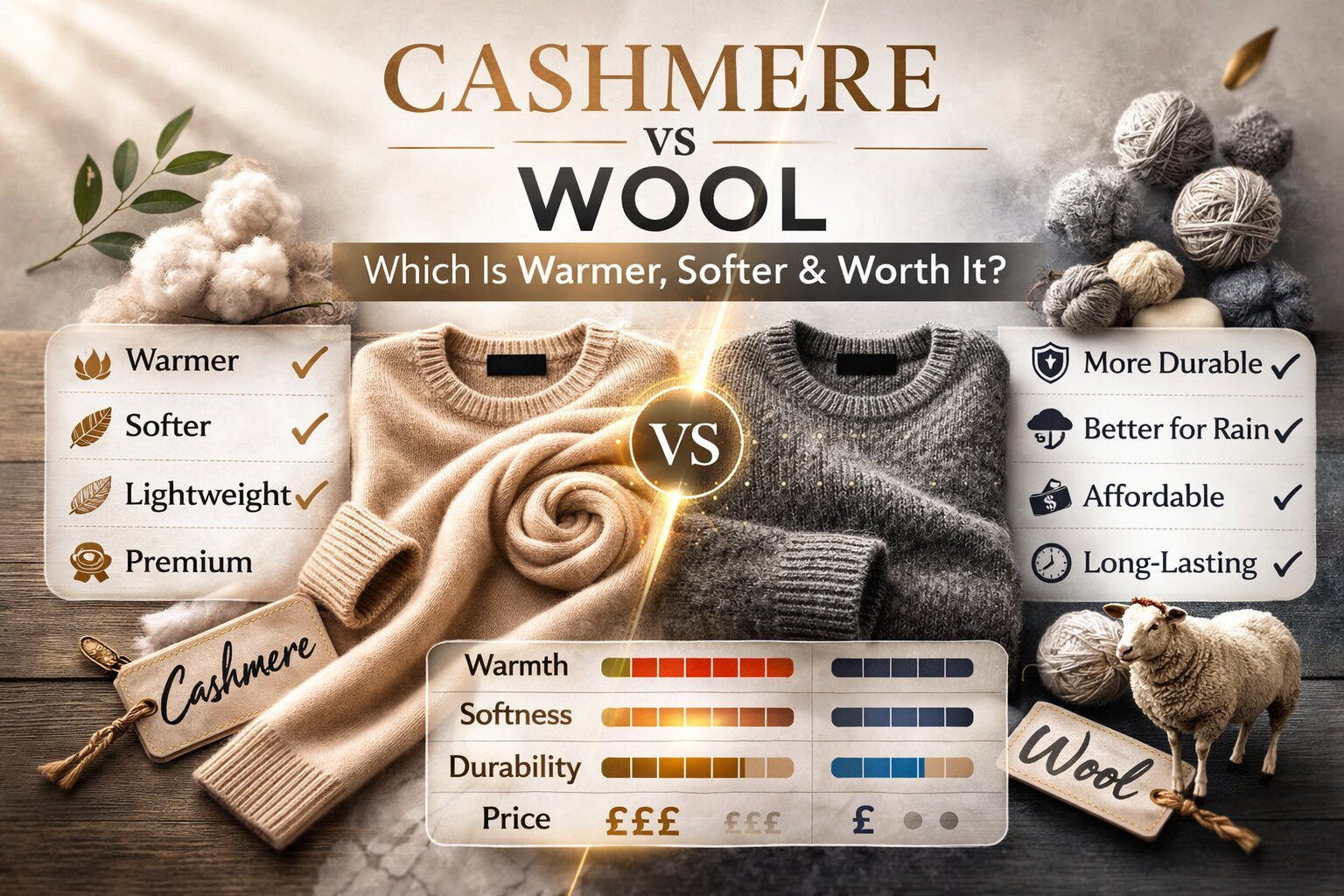
Most people think they know the difference between cashmere vs wool. They’re wrong — or at least, they only know half of it.
Yes, cashmere is softer. Yes, wool is cheaper. But that barely scratches the surface. The real differences between these two fibres go deeper than price tags and touch — and once you understand them, you’ll never shop for knitwear the same way again.
Here are 10 key differences between cashmere and wool, ranked, compared, and explained without the fluff.
Quick Comparison: Cashmere vs Wool at a Glance
| Feature | Cashmere | Wool |
|---|---|---|
| Warmth-to-weight | ★★★★★ | ★★★☆☆ |
| Softness | ★★★★★ | ★★★☆☆ |
| Durability | ★★★☆☆ | ★★★★★ |
| Moisture-wicking | ★★★☆☆ | ★★★★★ |
| Breathability | ★★★★★ | ★★★★☆ |
| Itch factor | Almost none | Varies widely |
| Price | Premium ($$$) | Affordable ($) |
| Weight | Feather-light | Medium to heavy |
| Weather resistance | Moderate | Good |
| Lifespan (with care) | 10–20+ years | 5–10 years |
Where They Come From
Before the comparison cashmere vs wool, one essential fact: these are two fundamentally different animals.
Wool comes from sheep. It is one of the most widely produced natural fibres in the world, harvested annually from millions of animals across every continent. The word “wool” covers an enormous range — from ultra-fine Merino to coarse Shetland — and quality varies massively depending on the breed, region, and processing.
Cashmere comes from the soft undercoat of cashmere goats, raised primarily across the high-altitude plateaus of Mongolia, Inner China, and the Kashmir region. Each goat produces just 150–200 grams of usable fibre per year. One sweater requires the annual yield of three to five goats. That scarcity is not marketing — it is biology, and it drives everything downstream: the price, the feel, the care required.
Now, the 10 differences that matter for cashmere vs wool.
1. Fibre Diameter — The Root of Everything
This is the number that explains almost every other difference on this list.
| Cashmere | Standard Wool | Merino Wool | Lambswool | |
|---|---|---|---|---|
| Fibre diameter | 14–19 microns | 20–40+ microns | 15–24 microns | 20–25 microns |
A micron is one millionth of a metre. When a fibre exceeds approximately 30 microns in diameter, it is stiff enough to press against skin rather than bend with it — triggering the nerve endings that register as itch or prickle. Cashmere, at 14–19 microns, almost always bends. Most standard wools, at 25–40 microns, often do not.
Everything — the softness, the warmth, the price, the delicacy — flows directly from this number.
Winner: Cashmere — finer fibres, by a significant margin.
2. Softness — No Contest
Ask anyone who has worn both: cashmere wins this comparison decisively and immediately.
The ultra-fine diameter of cashmere fibres means the fabric drapes against skin with almost no resistance. It does not scratch, prickle, or roughen with wear. Standard wool, depending on the type, can range from pleasantly textured to genuinely uncomfortable against bare skin. Even fine Merino, which is soft by wool standards, does not match the sensation of quality cashmere.
| Fibre | Softness Ranking |
|---|---|
| Cashmere | 1st — cloud-like, no prickle |
| Merino wool | 2nd — soft, slight texture |
| Lambswool | 3rd — soft but variable |
| Standard wool | 4th — often scratchy |
| Shetland/Aran wool | 5th — deliberately coarse |
Winner: Cashmere — and it is not close.
3. Warmth — Lighter, Warmer, Smarter
Cashmere is warmer than wool — but the real story is how it achieves that warmth.
Both fibres insulate by trapping air. The finer and more numerous the fibres in a given weight of material, the more air pockets the fabric holds, and the better it retains heat. Cashmere, with its exceptionally fine fibres, achieves outstanding air retention at very low weight.
| Comparison | Warmer Fibre |
|---|---|
| Cashmere vs standard wool | Cashmere — by a wide margin |
| Cashmere vs merino wool | Cashmere — by a modest margin |
| Cashmere vs lambswool | Cashmere — clearly warmer |
| Cashmere vs yak wool | Essentially equal — yak edges ahead by weight in some tests |
| Cashmere vs down (jackets) | Down wins for extreme cold; cashmere leads for everyday wear |
A lightweight cashmere sweater will keep you as warm as a significantly heavier wool sweater. That warmth-to-weight advantage is the reason cashmere coats can be cut thin and still perform in deep winter.
Winner: Cashmere — warmer per gram, lighter on the body.
4. Itchiness — Wool’s Biggest Problem
Wool’s itch problem is real — but it is misunderstood. It is not an allergy in most cases. It is a mechanical reaction: coarse fibres poking skin. The finer the fibre, the less it itches. Simple as that.
| Fibre | Itch Level |
|---|---|
| Cashmere | Almost never itchy |
| Merino wool | Rarely itchy |
| Lambswool | Occasionally itchy |
| Standard wool | Frequently itchy |
| Shetland / Icelandic wool | Often very itchy |
| Mongolian cashmere (low grade) | Can be itchy if fibres are coarser |
How to make wool less itchy:
- Wash with wool conditioner or a capful of hair conditioner in cool water
- Wear a thin cotton or silk layer underneath
- Choose merino or cashmere blends over standard wool
- Always check the micron count — the lower, the softer
Winner: Cashmere — the safest choice for sensitive skin.
5. Durability — Wool Fights Back
Here is where wool earns its reputation and cashmere requires honesty.
Wool fibres can be bent over 20,000 times before breaking. They spring back, resist abrasion, and handle rough treatment far better than cashmere. A wool sweater washed carelessly will survive. A cashmere sweater washed carelessly may not.
Cheap cashmere — made from short fibres and processed at speed — pills aggressively after just a handful of wears. This is where most cashmere scepticism comes from. Quality cashmere, made from long-staple Grade A fibres, is a different product entirely — genuinely durable over decades with the right care.
| Cashmere | Wool | |
|---|---|---|
| Resistance to pilling | Moderate (low-grade: poor) | Good |
| Shape retention | Good | Excellent |
| Resistance to abrasion | Lower | Higher |
| Longevity with proper care | 10–20+ years | 5–10 years |
| Forgiveness with rough handling | Low | High |
Winner: Wool — more resilient, less demanding, better for everyday rough use.
6. Moisture-Wicking — The Active Wear Factor
Both natural fibres manage moisture better than most synthetics, but they do it differently and to different degrees.
Merino wool is one of the finest moisture-wicking natural fibres in existence. It can absorb up to 30% of its own weight in moisture before feeling wet against skin, and it continues to insulate even when damp. This is why merino is the material of choice for base layers, hiking gear, and performance knitwear.
Cashmere does wick moisture, but it is not its strength. It absorbs moisture more slowly, insulates less effectively when wet, and takes longer to dry. For anyone considering cashmere as an active base layer — for skiing, hiking, or high-movement days — merino wool is the more practical choice.
| Use Case | Better Choice |
|---|---|
| Casual everyday base layer | Cashmere |
| Active / sport base layer | Merino wool |
| Cold weather without exertion | Cashmere |
| Cold weather with activity | Merino wool |
| Long days on your feet | Merino wool |
Winner: Wool (Merino specifically) — superior moisture management for active use.
7. Breathability & Temperature Regulation
Both fibres are naturally breathable and regulate body temperature far better than synthetic alternatives — but cashmere has a slight edge in this department due to its finer fibre structure and lower weight.
A cashmere sweater worn indoors in a heated room will feel noticeably less stuffy than an equivalent wool garment. The same fibre fineness that traps warmth outdoors allows better air circulation in warmer conditions. This is partly why cashmere has a reputation for being a “four season” fibre — genuinely wearable in spring and autumn, not just deep winter.
| Cashmere | Wool | |
|---|---|---|
| Indoor breathability | Excellent | Good |
| Temperature self-regulation | Excellent | Very good |
| Suitable for mild weather | Yes — lightweight pieces | Less so |
| Overheating risk | Low | Moderate (heavier weights) |
Winner: Cashmere — marginally more breathable, better suited to variable temperatures.
8. Weather Resistance — Wool’s Practical Edge
Neither cashmere nor standard wool is waterproof, but wool handles wet conditions more forgivingly than cashmere.
Both fibres contain lanolin — a natural waxy oil that gives them a degree of water repellency. Light rain or snow will bead on the surface before soaking in. Prolonged exposure to moisture is a different matter. Soaked wool loses some warmth temporarily but recovers well when dried. Soaked cashmere is more vulnerable — it can lose shape, become heavier, and requires careful flat drying to avoid damage.
| Weather Scenario | Better Choice |
|---|---|
| Light rain or snow | Either — both handle it reasonably |
| Heavy or prolonged rain | Wool — more forgiving when wet |
| Dry cold | Cashmere — warmer and lighter |
| Snowy city conditions | Cashmere (with outer layer) |
| Outdoor / rural winter | Wool — more practical |
Is cashmere good for snow? Yes — for city winters and casual snow exposure. Pair with a water-resistant outer layer for heavier conditions.
Winner: Wool — handles wet weather better and recovers more easily.
9. Price & Value — The Honest Calculation
Cashmere costs more. The question is whether the premium is justified — and the answer depends entirely on which cashmere you are buying.
| Product | Wool (approx.) | Cashmere (approx.) |
|---|---|---|
| Sweater | £40–£100 | £100–£400+ |
| Coat | £80–£250 | £250–£1,000+ |
| Scarf | £20–£60 | £60–£200+ |
| Socks | £10–£25 | £25–£80+ |
| Gloves | £15–£40 | £40–£120+ |
The critical distinction is between Grade A long-staple cashmere — which genuinely lasts decades and maintains its softness — and cheap, short-fibre cashmere that pills within weeks. Fast-fashion cashmere at £30 is not a bargain. It is a disappointment waiting to happen.
What to look for when buying cashmere:
- 2-ply construction — more durable than single-ply
- Grade A fibres — 14–16 microns, longest staple length
- Mongolian or Scottish processing — widely regarded as the quality benchmark
- Weight and density — quality cashmere feels substantial, not wispy
- Price — genuine quality rarely starts below £100 for a sweater
Winner: Wool for budget | Cashmere for long-term value — if you buy quality.
10. Versatility — What Each Fibre Does Best
| Garment | Best Choice | Why |
|---|---|---|
| Next-to-skin sweater | Cashmere | Softer, warmer, no itch |
| Active base layer | Merino wool | Better moisture management |
| Winter coat | Cashmere (city) / Wool (outdoor) | Depends on use |
| Scarf | Cashmere | Softer against neck and face |
| Socks (casual) | Cashmere | Supreme everyday comfort |
| Socks (active/hiking) | Merino wool | Moisture management |
| Gloves | Cashmere | Softer and warmer for daily wear |
| Blanket | Wool | More durable, easier to wash |
| Travel knitwear | Cashmere | Lightweight, packs small |
| Outdoor workwear | Wool | More rugged, weather-resistant |
Winner: Tie — they genuinely complement each other. The best wardrobe uses both.
The Blends: When Cashmere Meets Wool
A cashmere-wool blend deserves its own mention because it is genuinely a good middle ground — not a compromise, but a considered choice.
A 70/30 or 80/20 wool-cashmere blend picks up durability and resilience from the wool component while gaining the softness and warmth improvement that even a small percentage of cashmere brings. For coats especially, a quality cashmere-wool blend often outperforms pure cashmere in practical daily use while still feeling noticeably finer than a purely wool garment.
Cashmere vs Wool : Final Verdict
| Cashmere | Wool | |
|---|---|---|
| Warmth | ✅ Winner | |
| Softness | ✅ Winner | |
| No itch | ✅ Winner | |
| Durability | ✅ Winner | |
| Moisture-wicking | ✅ Winner | |
| Weather resistance | ✅ Winner | |
| Affordability | ✅ Winner | |
| Breathability | ✅ Winner | |
| Lightweight | ✅ Winner | |
| Long-term value | ✅ (if quality) |
Cashmere wins 6. Wool wins 4.
But that scoreline misses the point. These fibres are not enemies. They are specialists. Cashmere does things wool cannot — and wool does things cashmere should not be asked to do. The right question was never which is better. It was always which is better for what you need.
Frequently Asked Questions About Cashmere vs Wool
1. Is cashmere warmer than wool?
Yes, cashmere is warmer than wool by weight. Its finer fibres trap more air, providing better insulation while remaining lighter and less bulky.
2. Is cashmere softer than wool?
Yes, cashmere is much softer than wool. Its ultra-fine fibres create a smooth, non-itchy feel, making it more comfortable for direct contact with skin.
3. Why is cashmere more expensive than wool?
Cashmere is more expensive because it is rare and labor-intensive. Each goat produces limited fibre annually, and the collection process requires careful hand-combing.
4. Does wool itch more than cashmere?
Yes, wool can itch more than cashmere. Coarser wool fibres can irritate the skin, while cashmere’s finer fibres bend easily and rarely cause discomfort.
5. Which is better: cashmere or wool?
Cashmere is better for softness, warmth, and luxury, while wool is better for durability, affordability, and everyday use. The best choice depends on your needs.
6. Is cashmere worth the money?
Yes, high-quality cashmere is worth the investment. It offers superior softness, warmth, and longevity when properly cared for, making it a long-term wardrobe staple.
7. Which lasts longer: cashmere or wool?
Wool generally lasts longer because it is more durable and resistant to wear. However, premium cashmere can last many years with proper care.
8. Is merino wool better than cashmere?
Merino wool is better for active wear due to its moisture-wicking and durability, while cashmere is better for softness, warmth, and comfort in everyday wear.
9. What is better for winter: cashmere or wool?
Both are excellent for winter. Cashmere provides lightweight warmth, while wool offers durability and better performance in harsh or wet conditions.
10. Are cashmere and wool blends good?
Yes, cashmere-wool blends are a great option. They combine the softness of cashmere with the durability and affordability of wool.
At Rita Cashmere, we work exclusively with Grade A cashmere because we believe quality is not a luxury — it is the only standard worth setting. Explore our collection and discover what genuinely fine knitwear feels like.
[…] To understand how pashmina compares to other premium fibers, read our in-depth breakdown: Cashmere vs Wool: 10 Key Differences That Actually Matter […]