
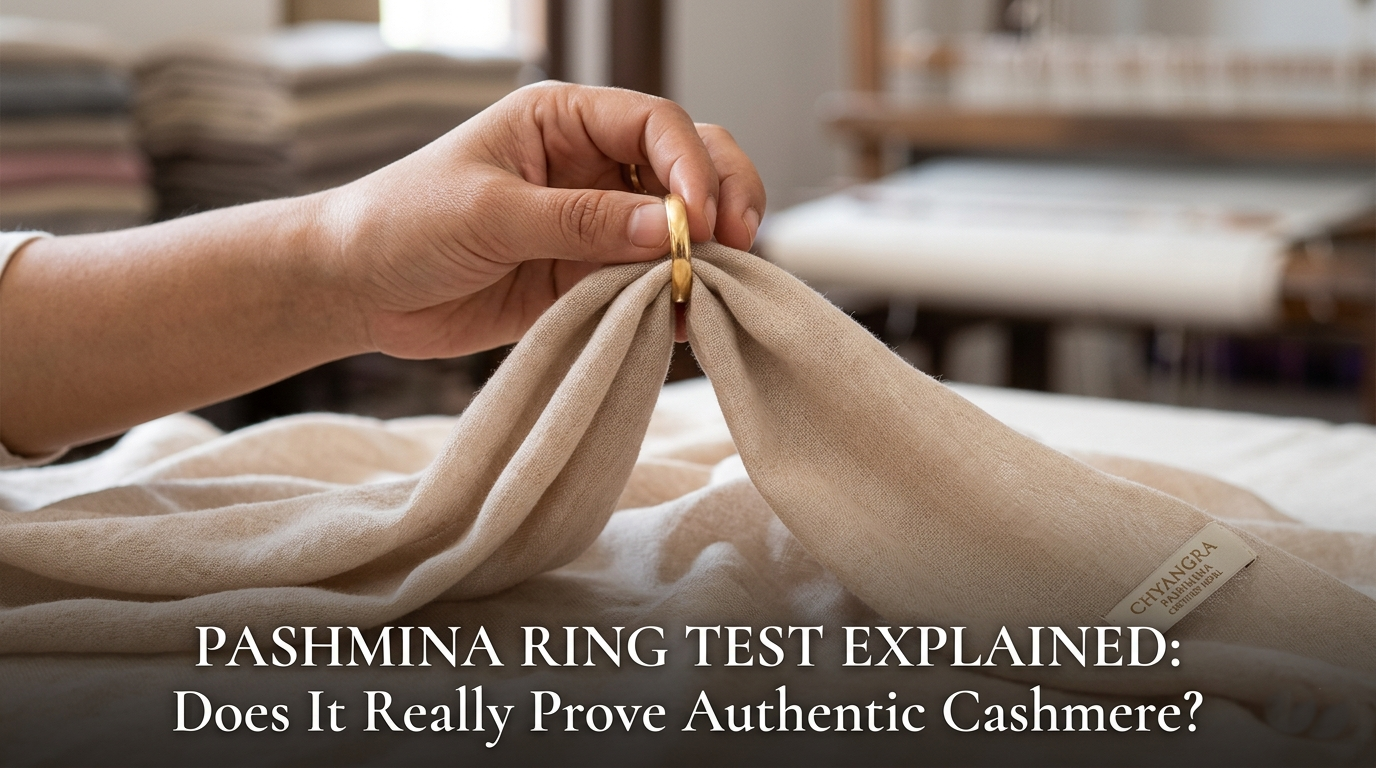
Can a simple ring really prove if your pashmina is real? Many sellers say yes — but the truth might surprise you.
The pashmina ring test is one of the most common methods used to verify cashmere authenticity — in markets, boutiques, and increasingly in social media videos.
You’ve probably seen it: a full-sized shawl threaded effortlessly through a finger ring, offered as instant proof of quality. But does the cashmere ring test actually prove anything? And does the ring test prove pashmina is genuine?
At Rita Cashmere, we believe honest answers build better buyers. So let’s break this down properly.
Does the pashmina ring test prove authenticity?
No — the pashmina ring test only shows that a fabric is fine and compressible. It does not confirm whether the fiber is genuine cashmere or pashmina. Many synthetic and blended fabrics can also pass the test easily.
What Is the Pashmina Ring Test?
The pashmina ring test — also called the cashmere ring test — is one of the oldest demonstrations in the pashmina trade. The method is simple:
- Take a pashmina shawl or stole
- Attempt to pass it through a finger ring or small metal ring
- If it slides through smoothly → the fiber is considered fine and authentic
The logic comes from the nature of genuine Himalayan pashmina fiber. Real pashmina from the mountain goat (Capra hircus) measures between 12 to 16 microns in diameter — finer than the finest merino wool, far thinner than a human hair. In theory, such delicate fiber, when woven into a shawl, should be light and compressible enough to pass through a ring.
So far, so reasonable. But here’s where it gets complicated.
Why People Believe the Ring Test Works
The ring test has survived for generations because it’s not entirely wrong. There is a real connection between fiber fineness and a shawl’s ability to compress through a small opening.
Genuine handwoven pashmina is naturally lightweight (a full-sized shawl can weigh as little as 100 grams), incredibly soft due to its ultra-fine fiber structure, and delicately woven on traditional handlooms that create an open, airy construction.
When you see a shawl glide through a ring, it does tell you something — that the fabric is fine and lightweight. The problem is, that’s not the same as confirming it’s authentic pashmina.
❌ Why the Ring Test Is Misleading — The Truth Sellers Won’t Tell You
This is the section most sellers skip. Read it carefully.
1. Synthetic blends can pass too. Viscose, modal, and certain silk blends are extremely fine and fluid. A well-made viscose shawl can pass through a ring just as easily — sometimes more easily — than genuine pashmina. The cashmere ring test simply cannot distinguish between animal fiber and synthetic fiber.
2. Loose weaving tricks the test. A loosely woven fabric — regardless of fiber content — will compress and slide through a ring. Sellers who know this can deliberately weave fabric loosely to pass the test, even with low-quality or blended materials.
3. Not all genuine pashmina will pass. A tightly woven, high-quality pure pashmina shawl may not pass through a small ring — especially in thicker weaves. Does that make it fake? Absolutely not. It simply means the test was never a reliable standard to begin with.
4. There is no scientific basis. No fiber certification body, textile laboratory, or industry authority recognizes the ring test as a valid authentication method. The only way to scientifically confirm whether does ring test prove pashmina authenticity holds up — is through lab fiber analysis, checking micron count and fiber origin under a microscope.
The ring test is theater. Impressive theater — but theater nonetheless.
When the Ring Test Can Be Useful
To be fair: the ring test isn’t completely useless. It works as one rough indicator among many.
If a shawl fails the ring test and also feels heavy, coarse, or stiff — that’s a reasonable red flag worth noting.
If a shawl passes the ring test and also feels soft and warm, shows slight natural pilling when rubbed, and comes with proper origin documentation — it adds to a picture of authenticity.
The key word is one indicator. Not proof. Not a guarantee. One data point in a larger assessment.
🔍 Better Ways to Identify Real Pashmina
If you want genuine confidence, here are the methods that actually matter:
Burn Test: Carefully burn a few fringe threads. Genuine pashmina smells like burning hair, forms a crushable ash, and self-extinguishes. Synthetics melt, smell chemical, and leave a hard bead. (Fringe threads only, carefully.)
Texture and Hand Feel: Real pashmina feels warm and buttery soft against skin — not slippery like silk, not scratchy like wool. It has a subtle natural dryness synthetics can’t replicate.
The Warmth Test: Hold the shawl against your cheek for a few seconds. Genuine pashmina warms quickly from your body heat. Synthetics remain temperature-neutral.
Natural Pilling: Gently rub a small section between your fingers. Genuine pashmina produces tiny fiber pills — this is normal and confirms natural fiber. It’s a feature, not a flaw.
Price Realism: As we explain in Why Is Cashmere So Expensive?, authentic cashmere cannot be produced cheaply. If the price seems too good to be true, it almost certainly is.
Certification: Look for the Chyangra Pashmina label — Nepal’s government-backed certification for genuine pashmina. Reputable sellers provide documentation of fiber origin and processing.
👉 For the complete authentication checklist, read our full guide: How to Identify a Genuine Pashmina Shawl (Real vs Fake Buyer Guide)
Why Sellers Use the Ring Test in Marketing
If the ring test isn’t reliable, why do so many sellers keep using it?
The answer is simple — it’s visual, dramatic, and memorable.
It creates an immediate “wow” moment that builds buyer confidence on the spot. It makes for compelling in-store demonstrations and viral social media content. It requires no equipment, no expertise, and no documentation. And most buyers simply don’t know enough to question it.
There’s nothing necessarily dishonest about demonstrating the ring test — but a seller who only offers it as proof of authenticity, with no other verification, should give you pause.
At Rita Cashmere, we don’t rely on tricks. We rely on traceable sourcing, certified fiber, and craftsmanship that speaks for itself.
About Chyangra Pashmina: Why One Trick Is Never Enough
The fiber that makes genuine Nepali pashmina extraordinary cannot be reduced to a single demonstration.
As we cover in depth in What Is Chyangra Pashmina? The Complete Guide to Nepal’s Finest Himalayan Cashmere, this fiber comes from the undercoat of the Himalayan mountain goat raised at altitudes above 14,000 feet in Nepal’s trans-Himalayan regions. The extreme cold causes these goats to develop an exceptionally fine, warm undercoat — the raw material for one of the world’s finest natural textile fibers.
Producing it involves a painstaking process:
- Hand-combing raw fiber during spring molting season
- Manual dehairing to remove coarse guard hairs
- Traditional hand-spinning on wooden spinning wheels
- Handloom weaving by skilled artisans
This is a product of geography, animal biology, and generations of human craft. It cannot be replicated in a factory — and it cannot be verified by passing it through a ring.
To understand how pashmina compares to other premium fibers, read our in-depth breakdown: Cashmere vs Wool: 10 Key Differences That Actually Matter
And for a full foundation on what makes this fiber special: What Is Cashmere? A Complete Guide to Authentic Cashmere
Conclusion: The Ring Impresses — But Doesn’t Authenticate
The pashmina ring test can impress — but it doesn’t guarantee authenticity. The cashmere ring test is a visual demonstration of fineness, not a scientific test of fiber origin, quality, or craftsmanship.
True pashmina is defined by where it comes from, the animal it comes from, and the hands that made it — not by how it moves through a piece of metal.
When shopping for genuine cashmere or pashmina, ask harder questions:
Where was this fiber sourced?
Is it certified Chyangra Pashmina?
Was it made by hand or machine?
Does the price reflect real production costs?
A seller who can answer these confidently has far more to offer than a ring demonstration.
Looking for Certified, Authentic Cashmere Directly from Nepal?
At Rita Cashmere, we work directly with Himalayan artisans to bring you genuine Chyangra pashmina — traceable, certified, and crafted with integrity.
Whether you’re a retailer, boutique owner, or individual buyer, we offer wholesale and private label options for businesses who want to offer their customers the real thing — not a ring trick.
FAQ: Pashmina Ring Test
Can fake pashmina pass the ring test?
Yes. Many synthetic or blended fabrics — including viscose and modal — are fine enough to pass the ring test easily. Passing the test does not confirm genuine cashmere or pashmina fiber.
Do all real pashmina shawls pass the ring test?
No. Tightly woven authentic pashmina may not pass through a small ring. Failing the ring test does not automatically mean a shawl is fake.
What is the best way to test real pashmina?
The most reliable method is professional lab testing to verify micron count and fiber origin. At home, combine the burn test, texture check, warmth test, and price realism — and always look for Chyangra Pashmina certification.
Is the cashmere ring test the same as the pashmina ring test?
Essentially yes — both refer to the same method of threading a shawl through a finger ring to assess fiber fineness. Neither test is a scientifically validated method of authentication.
Why do sellers use the ring test if it’s unreliable?
Because it’s visually impressive, easy to demonstrate, and most buyers don’t know its limitations. It builds quick confidence without requiring any documentation or certification.
👉 Explore Our Wholesale & Private Label Options 👉 Shop Authentic Pashmina Shawls