
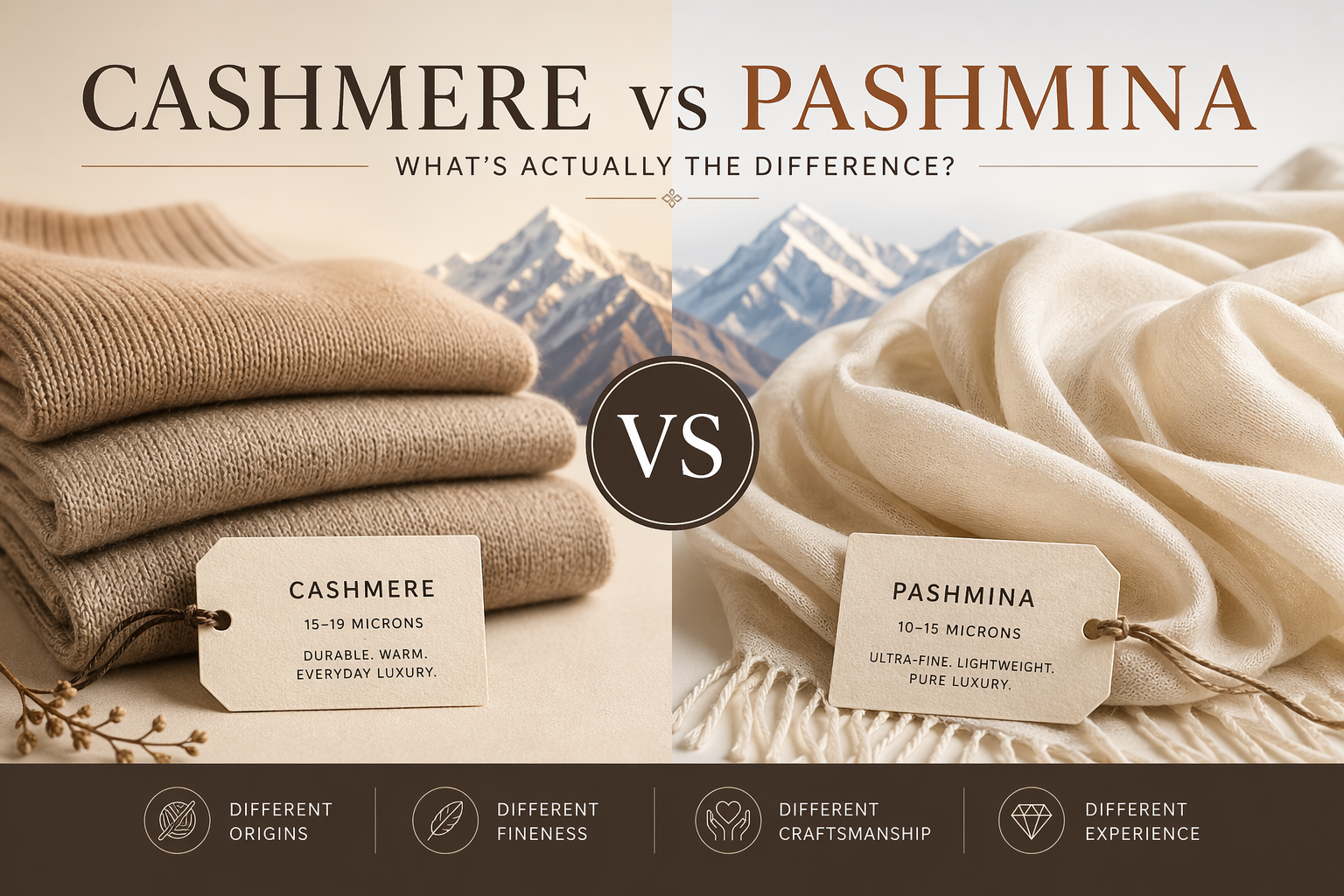
Cashmere is a premium wool sourced from goats worldwide, with fibers measuring 15–19 microns. Pashmina is the finest grade of cashmere, sourced exclusively from Himalayan Chyangra goats, with ultra-fine fibers of just 10–15 microns. Pashmina is softer, lighter, and more luxurious — cashmere is more durable and better suited for everyday wear.
The rule that clears everything up: All pashmina is cashmere. But not all cashmere is pashmina.
What is the Difference Between Cashmere and Pashmina?
They’re draped side by side in luxury boutiques. They appear together on fashion blogs and gift guides. And yet, cashmere and pashmina are almost always described as if they’re the same thing.
They’re not.
Pashmina is a subcategory of cashmere — so exceptional in fiber quality, origin, and craftsmanship that it has earned its own name, its own tradition, and its own place at the top of the luxury textile world. Standard cashmere is broader: still premium, still beautiful, but produced on a larger scale and across a wider geography.
Everything else follows from this distinction.
Cashmere vs Pashmina: Side-by-Side Comparison
| Feature | Cashmere | Pashmina |
|---|---|---|
| Source | Goats from Mongolia, China, Iran, Nepal | Chyangra goats (Himalayas only) |
| Fiber Diameter | 15–19 microns | 10–15 microns |
| Annual Yield Per Goat | 200–300g | 80–150g |
| Processing | Machine or hand-spun | Always hand-spun & handwoven |
| Feel | Very soft | Exceptionally soft, almost weightless |
| Warmth | Excellent | Exceptional for its weight |
| Durability | High — ideal for daily wear | Delicate — best for occasional wear |
| Best For | Sweaters, knitwear, scarves | Shawls, wraps, luxury scarves |
| Price | Moderate to high | Premium |
What is Cashmere?
Cashmere is a natural fiber combed from the soft undercoat of cashmere goats, raised across Mongolia, China, Iran, Afghanistan, and the Himalayan foothills. The fibers measure between 15 and 19 microns — significantly softer than standard wool and up to eight times warmer.
Because cashmere is produced at scale, it can be machine-spun and machine-woven efficiently — which makes it more accessible without sacrificing luxury. This is the fiber behind the world’s finest sweaters, the softest gloves, and knitwear built to last for years.
Cashmere is a luxury fiber built for real life.
What is Pashmina?
Pashmina comes from the Chyangra goat, found only in high-altitude regions of the Himalayas — primarily Nepal and Ladakh, India. These animals graze above 14,000 feet, where temperatures regularly drop below freezing, and they develop an extraordinarily fine inner fleece as a result.
That fleece — pashmina — measures just 10 to 15 microns in diameter. A single human hair is roughly 70 microns wide. Pashmina is so fine it can barely be felt between the fingers.
Each Chyangra goat yields only 80 to 150 grams of usable pashmina per year — gently hand-combed during the spring molting season, never mechanically shorn. That raw fiber then passes through the hands of skilled artisans: hand-spun on traditional wooden spinning wheels, then handwoven on wooden looms, thread by thread. A single pashmina shawl can take weeks to complete.
Pashmina is not just a fabric. It is a living craft tradition.
Key Differences Between Cashmere and Pashmina
1. Fiber Fineness
Pashmina fibers (10–15 microns) are measurably finer than even the best standard cashmere (15–19 microns). Finer fibers mean a softer hand feel, a lighter drape, and greater warmth relative to weight — along with greater delicacy.
2. Origin and Rarity
Standard cashmere comes from multiple countries and multiple goat breeds. Authentic pashmina has only one source: the Chyangra goat of the Himalayas. This exclusivity, combined with each animal’s limited yield, makes pashmina genuinely rare.
3. Production Method
Most cashmere is processed using modern machinery — efficient and consistent. Authentic pashmina is processed entirely by hand. The hand-spinning gives pashmina its characteristic texture; the handweaving gives each piece a subtle uniqueness that machine production cannot replicate.
4. Durability
Finer fibers, while softer, are more delicate. Cashmere holds its structure better over time and resists daily wear. Pashmina requires careful handling — gentle washing, thoughtful storage, and occasions rather than everyday use.
5. Price
Pashmina commands a higher price for straightforward reasons: limited supply, labor-intensive production, and fiber quality that sits at the very top of what nature offers.
Which is Warmer: Pashmina or Cashmere?
Both are among the warmest natural fibers available — far superior to standard wool for warmth-to-weight ratio. But they warm differently.
Pashmina traps body heat exceptionally efficiently without any bulk. Wearing a pashmina wrap in cool weather feels almost paradoxical — so light, yet so warm. It’s insulation that surprises you.
Cashmere, being denser and more structured, is better suited for sustained cold-weather layering. A thick cashmere sweater will shield you from bitter winter wind in a way that a delicate pashmina wrap cannot.
For warmth relative to weight: pashmina wins. For serious cold-weather protection: cashmere is the more practical choice.
Which is Better: Pashmina or Cashmere?
Neither is universally better — they serve different purposes.
Choose pashmina if:
- You want the softest, most luxurious textile available
- You’re buying a gift that needs to feel genuinely special
- You’re looking for an elegant shawl or wrap for occasions
- You value artisan craftsmanship and living cultural heritage
Choose cashmere if:
- You want something you’ll wear regularly without worry
- You need sweaters, knitwear, or structured winter garments
- You want the best balance of luxury, warmth, and practicality
- You’re investing in pieces built to last for years
A well-considered wardrobe has room for both.
Why is Pashmina More Expensive Than Cashmere?
The price difference comes down to three factors working together:
Scarcity. Each Chyangra goat produces only 80–150 grams of pashmina fiber annually — a fraction of what standard cashmere goats yield. There is simply not much of it in the world.
Labor. Every authentic pashmina product is hand-combed, hand-spun, and handwoven. A single shawl can represent weeks of skilled artisan work. That labor is irreplaceable and cannot be automated without destroying what makes pashmina exceptional.
Fiber quality. At 10–15 microns, pashmina sits at the finest end of what any natural fiber can achieve. That quality comes at a cost — and commands a price to match.
Want a deeper breakdown of pricing, sourcing, and what really drives luxury fiber costs? Read our complete guide on why cashmere is so expensive.
Is Pashmina the Same as Cashmere?
No — though the terms are often used interchangeably, they are not the same. Pashmina is a specific, premium-grade subset of cashmere defined by its fiber fineness, geographic origin, and hand-processing tradition. Standard cashmere, while still luxurious, is broader in source, slightly coarser in fiber, and typically machine-processed.
Think of it this way: pashmina is to cashmere what single-malt Scotch is to whisky. Related, but categorically different at the top end.
How to Identify Authentic Pashmina
The market is flooded with products labeled “pashmina” that contain little to no Chyangra fiber — often blended with silk, viscose, or synthetics to reduce cost.
Here’s how to identify the real thing:
The burn test. Authentic pashmina, like all animal fibers, burns slowly and smells faintly of burnt hair. Synthetic blends melt, bead, and smell of burning plastic. This is one of the most reliable at-home tests available.
The feel. Real pashmina is almost impossibly soft without feeling slippery or cool to the touch. Silk blends feel smooth but slightly cool; synthetics often have a faint waxy or plastic quality.
The price. If a “pashmina” shawl is priced at a few dollars, it is not pashmina. Authentic handwoven pashmina reflects rarity and labor in its cost — and that price is never negligible.
The source. Buy from producers with transparent supply chains and direct connections to Himalayan artisans. Nepal and Kashmir remain the world’s most trusted sources for genuine pashmina.
Note: The traditional “ring test” — passing a shawl through a finger ring — is often cited but unreliable on its own. Very thin synthetic or silk-blended fabrics can also pass through a ring. For a deeper explanation of how this test works and its limitations, read our detailed guide on the pashmina ring test
Why Nepal Stands Apart
Nepal occupies a unique position in the world of luxury fibers. It is home to the Chyangra goat — the only source of true pashmina — and has maintained a living tradition of hand-spinning and handweaving that stretches back centuries.
Nepalese artisans don’t merely process fiber. They carry forward a craft that is simultaneously art, livelihood, and cultural inheritance. The best pashmina from Nepal reflects all of this: not just the exceptional quality of the fiber, but the skill, patience, and pride of the hands that shaped it.
Nepal is also a significant producer of premium-grade cashmere knitwear, with manufacturers who combine traditional expertise with modern quality standards to serve global fashion brands. For buyers seeking ethical sourcing, traceable supply chains, and genuine Himalayan quality, Nepal remains the destination of choice.
The Bottom Line
Cashmere and pashmina are both extraordinary — but they are not the same, and treating them interchangeably does a disservice to both.
Cashmere is luxury made practical: enduring, versatile, and built for the rhythm of daily life. Pashmina is luxury in its purest form: rare, delicate, and carrying within it the skill of generations of Himalayan artisans.
When you know the difference between cashmere and pashmina, you know exactly what you’re buying — and you can choose with confidence.
Looking for a Trusted Cashmere & Pashmina Manufacturer in Nepal?
Rita Cashmere works with global fashion brands, retailers, and wholesalers to deliver premium Himalayan fiber products — ethically sourced, expertly crafted, and export-ready.
We offer:
- OEM / ODM production
- Private label manufacturing
- Export-ready bulk orders
- Transparent, ethical sourcing direct from Nepal
Frequently Asked Questions
Is pashmina just a marketing term for cashmere?
No. Pashmina refers specifically to fiber from the Chyangra goat with a diameter of 10–15 microns. While the term has been widely misused in the market, authentic pashmina is a distinct and verifiable product with its own standards and heritage.
What is the difference between cashmere and pashmina price?
Authentic handwoven pashmina shawls typically cost significantly more than standard cashmere products of comparable size — reflecting the rarity of the fiber, the limited annual yield per goat, and the weeks of artisan labor required. Cashmere knitwear, while still premium, benefits from greater production scale.
Is pashmina vs cashmere warmth really that different?
Both are exceptional insulators. Pashmina offers superior warmth-to-weight ratio — remarkable warmth from an almost weightless fabric. Cashmere provides more substantial, structured warmth better suited for heavy winter wear.
Can pashmina be machine-washed?
It’s strongly advised against. Hand wash in cold water with a gentle detergent, or dry clean. Fine fibers can felt and lose their structure with heat or agitation.
How long does cashmere last?
With proper care — gentle washing, folded storage, cedar protection from moths — quality cashmere can last 20 years or more. It often softens with careful use over time.
Why does some cashmere pill so much?
Pilling reflects fiber quality. Lower-grade cashmere uses shorter fibers that loosen with wear. High-grade cashmere uses longer, stronger fibers that stay integrated. Heavy pilling from the start usually signals lower-quality raw material.
Contact us today to start your collection.