
You’ve designed your collection, found your inspiration, and maybe even built out your brand identity — but now comes the most critical decision you’ll make as a fashion entrepreneur: how do you actually manufacture your products?
For most buyers, this is where things get confusing. OEM, ODM, Private Label — the terms get thrown around interchangeably, yet they represent fundamentally different business models. Choose the wrong one and you’re looking at wasted budgets, production delays, and a product that doesn’t reflect your brand vision. Choose the right one and you unlock a streamlined path to market with margins that actually work.
This guide breaks down all three models clearly, so you can walk away knowing exactly which manufacturing approach fits where your brand is today — and where it’s going.
Why Choosing the Right Clothing Manufacturing Model Matters
Your manufacturing model isn’t just a logistics decision — it shapes every corner of your business. It determines how much control you have over design, how fast you can get to market, how much you’ll spend upfront, and how different your product will look compared to your competitors.
Get it wrong and the consequences show up fast: a startup burns through capital on high minimum order quantities (MOQs) it can’t move, or an established brand discovers its “custom” product is being sold by five other companies under different labels.
The right model, matched to your brand’s stage and goals, is the difference between scaling confidently and spinning your wheels.
What Is OEM in Clothing Manufacturing?
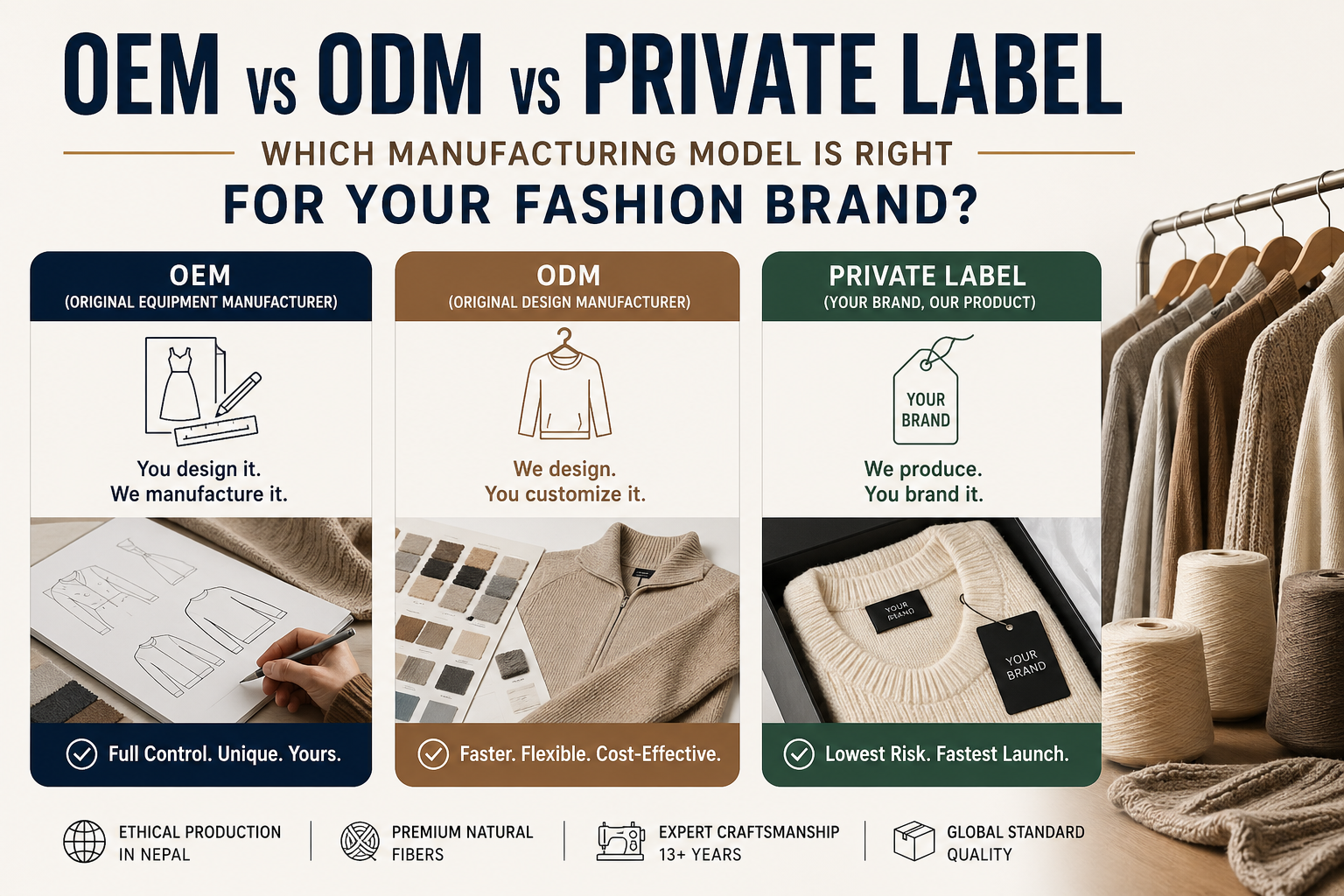
OEM manufacturing means the factory produces garments based entirely on your designs and specifications. You own the creative direction — the manufacturer simply has the expertise and infrastructure to bring it to life.
How It Works
You come to the table with your tech pack: your design files, material specifications, measurements, construction details, and finish requirements. The manufacturer follows your blueprint precisely. Nothing goes into production that you haven’t approved.
Pros
- Full design control — your product is truly yours
- Unique, brand-specific output — competitors can’t replicate it
- Strong brand identity — every detail reflects your creative vision
Cons
- Higher MOQs, since production is set up specifically for your design
- Longer development timelines — sampling and approvals take time
- Requires solid technical knowledge; vague briefs lead to costly mistakes
Best For
Established brands with a clear creative direction, designers who want total ownership of their product, and labels investing in long-term differentiation.
What Is ODM in Fashion Manufacturing?
With ODM, the manufacturer already has a library of existing designs — and you customize them to align with your brand. You’re working within a framework rather than building from scratch.
How It Works
You browse the manufacturer’s catalog and select base styles that resonate with your collection direction. From there, you collaborate to modify colors, fabrics, trims, and branding elements. The structural design exists; you shape how it looks and feels for your customer.
Pros
- Faster production timelines — the hard design work is already done
- Lower development costs — no need to build tech packs from zero
- Smoother process — fewer back-and-forth sampling rounds
Cons
- Limited uniqueness — the base design may be available to others
- Risk that competitors sell similar-looking products
- Less room to fully express a distinctive brand identity
Best For
Growing brands that need to move quickly, buyers entering new product categories, and labels testing a new market before committing to full custom development.
What Is Private Label Clothing Manufacturing?
Private label means you select finished or near-finished products and sell them under your own brand. The product exists — you brand it.
How It Works
You choose from a manufacturer’s ready-made product range, then apply your logo, labels, tags, and packaging. The product itself stays largely unchanged; your brand identity is layered on top.
Pros
- Lowest MOQs — minimal production commitment
- Fastest launch timeline — products are already developed
- Low risk — ideal for testing demand before scaling
Cons
- No design ownership — the product isn’t exclusive to you
- Highly competitive landscape — similar products exist across many brands
- Less brand differentiation in a crowded market
Best For
Startups building their first collection, e-commerce sellers validating new niches, and brands looking to expand their range quickly without heavy development investment.
OEM vs ODM vs Private Label: Side-by-Side Comparison
| Feature | OEM | ODM | Private Label |
|---|---|---|---|
| Design Control | Full | Partial | None |
| MOQ | High | Medium | Low |
| Time to Market | Slow | Medium | Fast |
| Development Cost | High | Medium | Low |
| Product Uniqueness | High | Medium | Low |
| Technical Input Required | High | Medium | Low |
| Brand Differentiation | Strong | Moderate | Limited |
Which Manufacturing Model Is Right for Your Fashion Brand?
For Startups
If you’re launching your first collection or testing a new market, Private Label is your lowest-risk entry point. It lets you build your brand presence, understand your customer, and generate revenue — without the capital exposure of full custom development. Once you know what sells, you can graduate to ODM or OEM with confidence.
For Scaling Brands
If you have traction but need to move fast and keep costs manageable, ODM strikes the right balance. You get meaningful customization without the timeline and investment of full OEM production. It’s the smart middle ground for brands expanding their range or entering new categories.
For Luxury and Established Brands
If brand identity is everything — and for luxury, it is — OEM is non-negotiable. Your customer is paying for something they can’t find anywhere else. Full design control, unique construction, and materials chosen by you aren’t optional; they’re the product.
If you’re new to selecting materials for your collection, read our guide on cashmere vs wool to understand which fiber works best for your brand positioning. And if you’re sourcing premium cashmere specifically, our cashmere micron guide explains exactly what to look for — fiber quality makes or breaks your end product.
Real-World Example: How Brands Evolve Across Models
One startup brand we worked with launched with private label scarves to test demand in a new market. They kept investment low and moved fast. Within six months, they identified their best-selling colors and silhouettes — and used that data to transition into ODM, customizing existing designs to better match their brand aesthetic.
Today, that same brand produces full OEM collections with complete design ownership, their own tech packs, and a product line that no competitor can replicate.
This progression — Private Label → ODM → OEM — is one of the most capital-efficient paths to building a truly differentiated fashion brand. You don’t have to start at the top. You just have to start smart.
Common Mistakes Buyers Make When Choosing a Manufacturing Model
Even experienced buyers get this wrong. Here’s what to avoid:
Going OEM without a tech pack. Walking into OEM without detailed technical documentation leads to miscommunication, bad samples, and expensive re-dos. If you can’t spec it, you’re not ready for OEM.
Expecting low MOQs from OEM partners. Custom production requires setup, tooling, and dedicated production time. Low MOQs and full OEM rarely coexist — and pushing for both usually means compromising on quality.
Confusing ODM with Private Label. They’re not the same. ODM involves real customization — you’re shaping the product. Private label is branding an existing one. The distinction matters for pricing negotiations and exclusivity conversations.
Ignoring your long-term branding strategy. The cheapest model now can cost you your brand positioning later. A Private Label product that’s identical to what twelve other sellers are offering isn’t building you anything durable. Think two steps ahead.
Why Nepal Is an Ideal Base for OEM, ODM, and Private Label Knitwear
Nepal has quietly built one of the most respected reputations in ethical, craft-forward textile manufacturing — and it’s particularly well-suited for brands that care about both quality and story.
The country’s artisans bring generations of expertise in fine knitwear, with access to some of the world’s most prized natural fibers: Himalayan cashmere, yak wool, and pashmina. This isn’t commodity production — it’s skilled, small-batch manufacturing with the craftsmanship that luxury and contemporary brands demand.
Compared to European production, Nepal offers genuinely competitive pricing without the ethical compromises that come with fast fashion supply chains. The export infrastructure has matured significantly, and Nepal-based manufacturers are increasingly well-equipped to serve international buyers across all three manufacturing models.
For brands that want to tell a compelling sourcing story — ethical, sustainable, rooted in craft — Nepal isn’t just practical. It’s a competitive advantage.
How Rita Cashmere Supports All Three Manufacturing Models
At Rita Cashmere, we’ve spent over 13 years working with fashion brands across every stage of growth — from first-time founders launching a single hero product to established labels scaling multi-category collections.
OEM — Full Custom Knitwear Production Bring us your tech pack and creative vision. We manufacture precisely to your specifications using premium Himalayan cashmere and wool. Your design, your brand, built to your exact standard.
ODM — Ready Design Customization Explore our existing design catalog and we’ll customize it to fit your collection — colors, yarn weight, construction details, branding. Faster timelines, lower development cost, meaningful differentiation.
Private Label — Fast Branding Solutions Select from our ready-to-brand knitwear range and launch under your label quickly. Low MOQ, quick turnaround, and the quality your customers expect.
What sets us apart:
- 13+ years of export-focused knitwear production
- Flexible MOQ structures across all three models
- Cashmere, yak wool, and sustainable fiber specialization
- Export-ready production with international compliance standards
Start Your Manufacturing Conversation Today
Tell us your idea, target price, and quantity — we’ll recommend the right model within 24 hours.
📩 info@ritacashmere.com 🌐 www.ritacashmere.com
Frequently Asked Questions
What is OEM in clothing manufacturing? OEM (Original Equipment Manufacturer) in clothing means a factory produces garments based entirely on the buyer’s designs and specifications. The brand provides the creative direction — design files, material choices, measurements — and the manufacturer executes it. The finished product is unique to the brand and cannot be replicated by competitors.
Is private label clothing manufacturing profitable? Private label can be highly profitable, particularly in the early stages of a brand. Because development costs are low and timelines are short, you reach revenue faster with less upfront investment. The trade-off is lower product exclusivity. Profitability scales when you pair private label entry with strong branding and a clear customer acquisition strategy.
What MOQ should I expect from a clothing manufacturer? MOQ varies significantly by model. Private label can start as low as 20–50 units per style. ODM typically ranges from 50–200 units depending on customization depth. OEM MOQs are generally higher — often 100–500 units or more — because production is set up exclusively for your design. Always clarify MOQ expectations before entering into a manufacturing conversation.
Can I switch manufacturing models as my brand grows? Absolutely — and most successful brands do. A common progression is Private Label → ODM → OEM as the brand builds revenue, customer insight, and design capability. Starting lean and graduating into full custom production is a smart, capital-efficient path to brand ownership.
What is the difference between ODM and private label manufacturing? ODM involves genuine customization — you’re modifying an existing base design to reflect your brand. Private label means applying your branding to a product that remains essentially unchanged. ODM gives you more differentiation; private label gives you more speed. The right choice depends on how much uniqueness your brand strategy requires at this stage.