
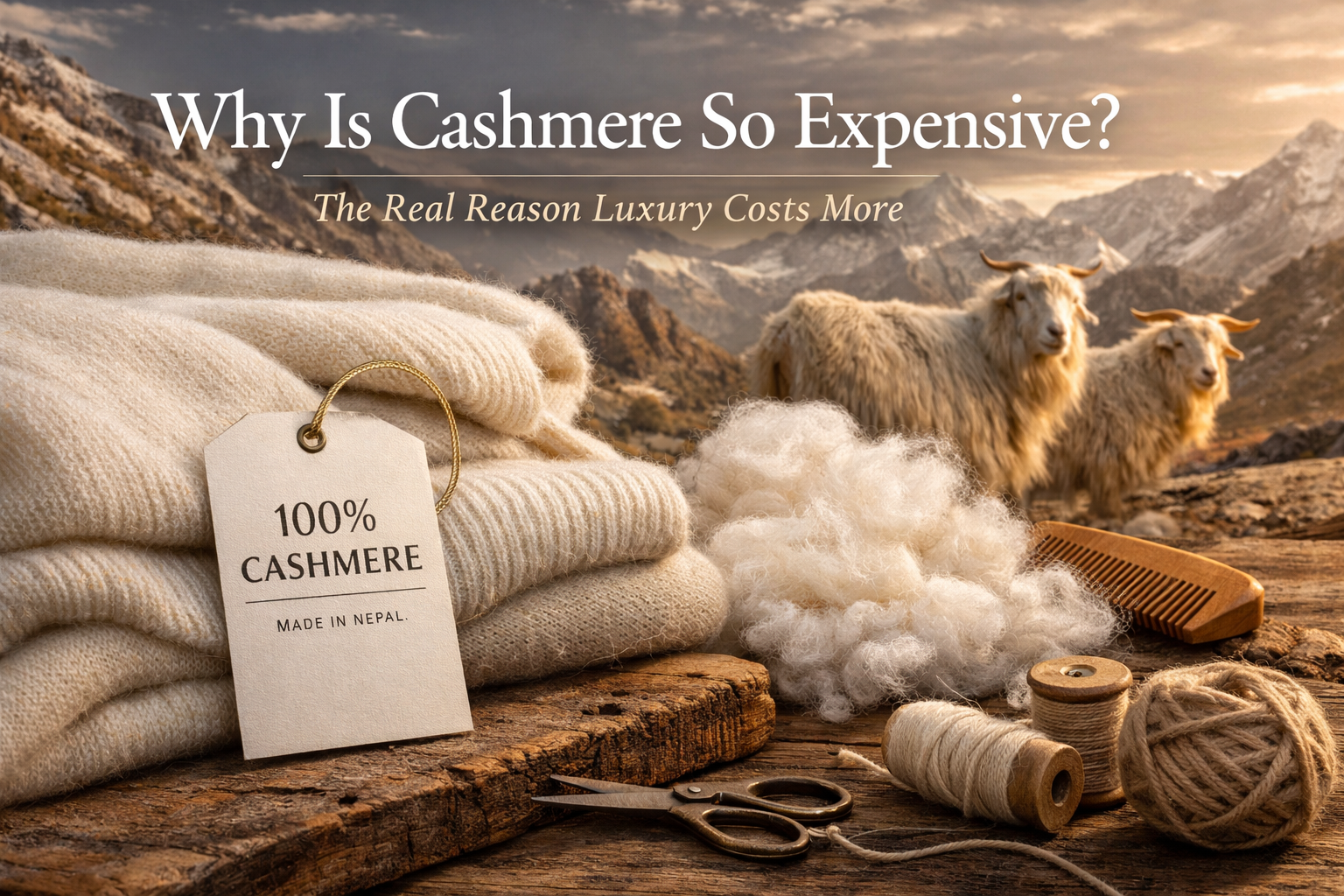
You picked up a cashmere sweater. You felt the softness. Then you flipped the tag — and paused.
Why is cashmere so expensive?
Here’s your honest answer: cashmere is expensive because nature makes it rare, humans harvest it entirely by hand, and the entire process simply cannot be rushed.
It’s not expensive because of branding. It’s not a markup trick. Cashmere is one of the rarest, most labor-intensive natural fibers in the world — and once you understand why, the price makes complete sense.
Let’s break it down properly.
Before we explore pricing, it helps to understand what cashmere is and how it’s made. You can read our complete guide here.
- OEM vs ODM vs Private Label: Which Manufacturing Model Is Right for Your Fashion Brand?
- Cashmere vs Pashmina: What’s Actually the Difference?
- Khullu Yak Wool vs Cashmere: Which Himalayan Fiber Is Truly Better?
- Pashmina Ring Test Explained: Does It Really Prove Authentic Cashmere?
- Cashmere Sweater Buying Guide: What to Look Before Buying
Why Is Cashmere So Expensive? 8 Real Reasons
1. One Goat Produces Almost Nothing
This is where the story really begins. A single cashmere goat yields only 150–200 grams of usable fiber per year. That means:
- 2–4 goats to make just one sweater
- Up to 30 goats to make one full-length coat
Compare that to a merino sheep, which produces several kilograms of wool annually. Cashmere represents less than 0.5% of global wool production. It is rare by definition — not by marketing.
2. It Is Harvested by Hand — Once a Year
Cashmere cannot be sheared like sheep’s wool. Every spring, during a short molting window of just a few weeks, herders sit down and hand-comb every single goat using fine-toothed combs. Goat by goat. Year after year.
If the process is rushed, fibers break. If fibers break, they pill. If they pill, the luxury disappears entirely.
That careful, unhurried harvesting is built directly into the price — and there is no workaround.
3. The Fiber Is Microscopic — and That’s the Point
Premium cashmere measures just 14–16 microns in diameter. For context, a human hair measures 50–100 microns. The finer the fiber, the softer the feel, the higher the insulation, and the more expensive the material.
True Grade A cashmere — the kind we use at Rita Cashmere — makes up only a fraction of annual global production. It is not common. It is not easy to find. And it absolutely cannot be faked.
4. Every Batch Must Be De-Haired and Sorted
Raw cashmere contains two very different things: soft undercoat fibers and coarse outer guard hairs. They look similar. They feel completely different. The two must be separated entirely — and this de-hairing process is one of the most critical, time-consuming steps in production.
Improper de-hairing is the main reason cheap cashmere turns scratchy and pills within weeks of first wear. At Rita Cashmere, only properly sorted, long-staple fibers make it through to the final product.
5. The Supply Simply Cannot Be Scaled
This is the truth that fast fashion cannot change: there are only so many goats. Only one harvest per year. Only limited land in the high-altitude climates where real cashmere thrives.
Unlike synthetic fabrics that can be produced on demand, cashmere supply is fixed by nature. When global demand rises — as it has sharply over the last two decades — prices rise with it. There is no factory solution for this. It is what it is.
6. Geography Adds Real, Unavoidable Cost
The finest cashmere fibers come from the high plateaus of Mongolia and the Himalayan regions of Nepal, where Chyangra goats raised above 4,000 meters produce exceptionally fine pashmina-grade fiber. Getting that raw fiber from a nomadic herder’s camp to a processing mill in Italy or Scotland involves overland logistics, careful handling, temperature control, and customs. Every kilometer adds cost. That’s not padding — that’s reality.
7. Craftsmanship Is Slow, Skilled, and Intentional
Once the fiber arrives at the mill, it must be washed, carded, spun, knitted or woven, then finished and inspected — each step handled by craftspeople who have spent years mastering their trade. Traditional mills in Biella, Italy and the Scottish Borders maintain decades-old standards of slow, careful production.
Cashmere cannot tolerate aggressive automation. Shortcuts destroy the softness. Luxury, by nature, requires patience.
8. Cheap “Cashmere” Is a Completely Different Product
If you’ve seen a $30–$40 cashmere sweater at a fast fashion retailer, here’s what’s actually in it: short-staple fibers, higher micron counts (19+ microns), wool or synthetic blends, and minimal de-hairing.
The result? Pilling after 2–3 wears, rapid loss of shape, and a rough texture that only gets worse with washing.
Real cashmere improves with time. Cheap cashmere deteriorates. They share a label. They are not the same product.
Is Cashmere Worth the Price?
Yes — when it’s real, absolutely yes.
Quality cashmere offers exceptional warmth without weight, natural breathability, hypoallergenic comfort, and a lifespan of 10 to 20+ years with proper care. It sheds no microplastics. It doesn’t need frequent washing. It gets softer the more you wear it.
Think about it this way: a $400 cashmere sweater worn 40 times per year for 10 years costs $1 per wear. That’s not expensive. That’s investment dressing — and it’s one of the smartest choices you can make for your wardrobe and the planet.
Cashmere vs Wool: Is Cashmere Actually Warmer?
Yes, and here’s why: cashmere fibers trap more air because they are finer and naturally hollow. This creates better insulation with significantly less weight. While wool is durable and affordable, cashmere offers a superior warmth-to-weight ratio that wool simply cannot match.
It’s why a thin cashmere layer feels warmer than a thick wool knit.
How to Identify High-Quality Cashmere Before You Buy
Not sure what you’re looking at? Here’s what separates real cashmere from imitation:
- ✔ Fiber thickness under 16 microns — this is the softness benchmark
- ✔ 2-ply construction — stronger, better drape, longer life
- ✔ Transparency about fiber origin — quality brands have nothing to hide
- ✔ Substantial weight — paper-thin is always a red flag
- ✔ Minimal early pilling — properly made cashmere should not pill heavily in the first season
If a brand can’t tell you where their fiber comes from, that says everything.
Why Rita Cashmere Is Different
At Rita Cashmere, we don’t chase trends or volume. We focus on:
- Long-staple Grade A fibers from ethically sourced, high-altitude regions
- Rigorous de-hairing and sorting for consistent softness
- Durable construction built to last decades, not seasons
- Full transparency about what goes into every piece
We protect craftsmanship because we believe true luxury is not about what’s trending. It’s about what lasts.
FAQ
Why is cashmere more expensive than regular wool?
Cashmere is more expensive than regular wool because it comes from the soft undercoat of goats, not sheep, and each goat produces only a small amount per year. The fiber is also finer, warmer, and rarer than standard wool, which increases its market value.
Why is real cashmere so rare?
Real cashmere is rare because it can only be harvested once a year during the natural molting season. Goats raised in extreme cold climates like Mongolia and Nepal produce limited quantities, making global supply very small compared to regular wool production.
What factors make cashmere prices higher?
Cashmere prices are influenced by fiber diameter (fineness), fiber length, origin, hand-combing labor, sorting quality, and ethical sourcing practices. Finer and longer fibers are more expensive because they produce softer and more durable garments.
Why is cheap cashmere available if it’s supposed to be expensive?
Cheap cashmere is usually made from shorter fibers, blended materials, or lower-grade raw fiber. These products may feel soft initially but tend to pill quickly and lose shape, which reduces long-term value.
Is expensive cashmere worth the price?
High-quality cashmere is worth the price because it offers exceptional warmth, softness, durability, and longevity. When properly cared for, premium cashmere can last many years, making its cost-per-wear lower than cheaper alternatives.
The Bottom Line
Why is cashmere so expensive?
Because it takes multiple goats a full year to produce fiber for one sweater. Because every strand is combed out by hand. Because supply is fixed by nature and cannot be manufactured on demand. Because every step — sorting, spinning, weaving, finishing — requires skilled hands and real time.
Cashmere is not overpriced.
It is rare, human, and time-intensive — and when it is made correctly, the way we make it at Rita Cashmere, it is worth every single penny.
Shop our collection of premium, ethically sourced cashmere — crafted for women who choose quality over everything.
[…] Realism: As we explain in Why Is Cashmere So Expensive?, authentic cashmere cannot be produced cheaply. If the price seems too good to be true, it almost […]