
The Himalayan Fiber Buying Guide You Actually Need
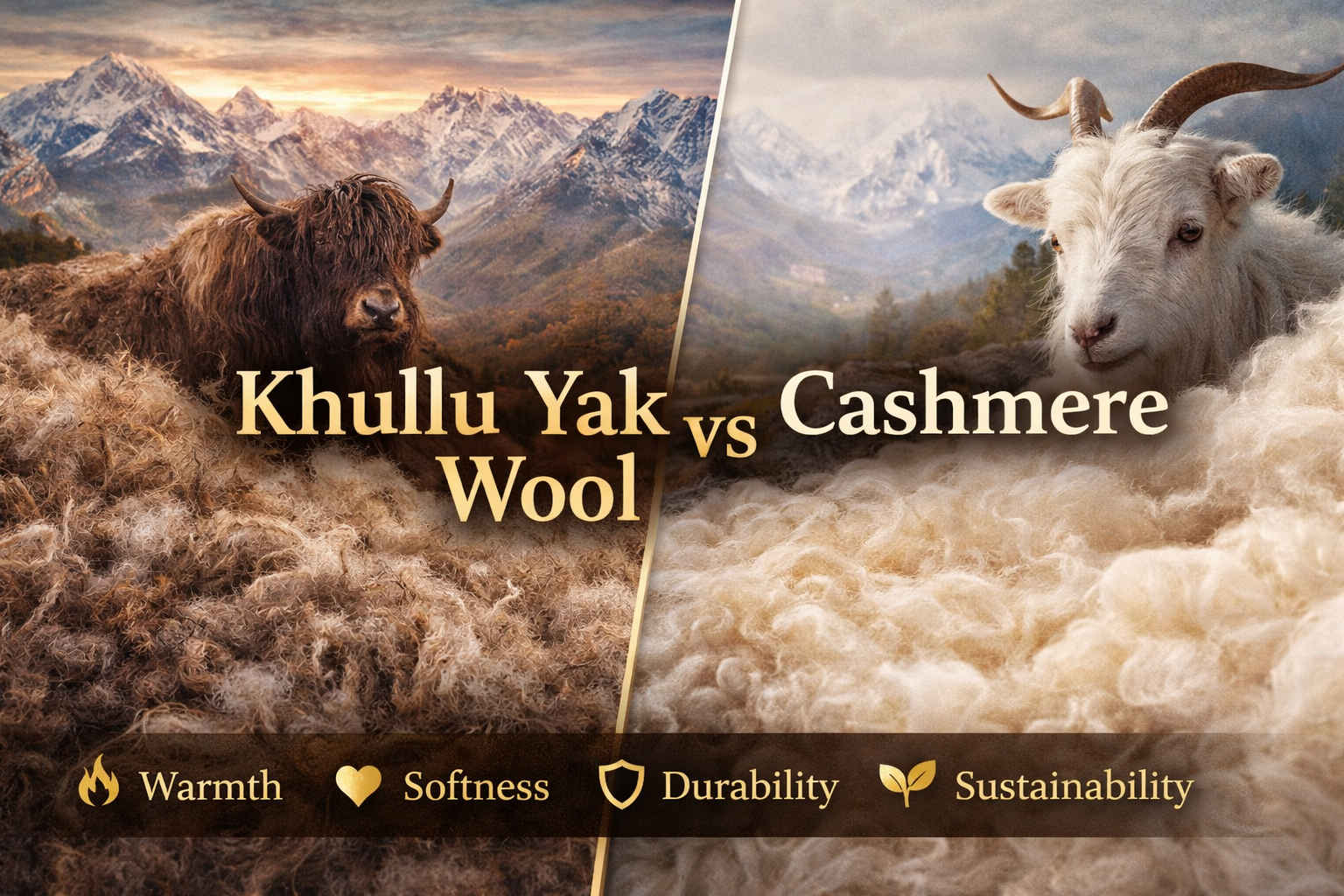
When comparing khullu yak wool vs cashmere, you are not choosing between good and bad — you are choosing between two extraordinary Himalayan fibers that each excel in different ways.
Both originate from the high-altitude landscapes of Nepal and Tibet, both are harvested by traditional mountain communities, and both deliver warmth and comfort that no synthetic fiber can replicate.
But they are not the same. And if you are investing in premium knitwear — whether as a consumer, a retailer, or a brand — understanding the real differences between yak wool and cashmere will help you make a decision you will not regret.
As a Nepal-based manufacturer, Rita Cashmere works directly with Himalayan fiber sources — giving us firsthand expertise in both khullu yak wool and Chyangra cashmere production that no distant importer or middleman can match. This guide reflects that on-the-ground knowledge: honest, balanced, and built to help you choose with confidence.
Quick Verdict: Khullu Yak Wool vs Cashmere at a Glance
| Property | Winner |
|---|---|
| Warmth | 🟤 Yak Wool — superior hollow-fiber insulation |
| Softness | ⬜ Cashmere — slightly finer micron count |
| Durability | 🟤 Yak Wool — stronger, pills less |
| Sustainability | 🟤 Yak Wool — lower environmental impact |
| Luxury Feel | ⬜ Cashmere — global prestige and heritage |
| Value for Money | 🟤 Yak Wool — outlasts cashmere at lower cost |
| Fashion Versatility | ⬜ Cashmere — wider color range, lighter weight |
Bottom line: Yak wool is the modern, sustainable, high-performance fiber. Cashmere is the classic luxury choice. Your lifestyle determines the winner.
What is Khullu Yak Wool?
Khullu is the exceptionally fine undercoat naturally shed each spring by the Himalayan yak (Bos grunniens). The word comes from Nepali and Tibetan languages and refers specifically to this premium inner fiber — not the coarser outer hair of the animal, but the soft, dense underlayer that protects yaks from some of the planet’s most extreme cold.
Yaks live at elevations between 3,000 and 6,000 meters across Nepal, Tibet, Bhutan, and the wider Himalayan plateau. At these altitudes, temperatures plunge far below freezing for months at a time, and the yak’s undercoat has evolved over millennia into one of nature’s most efficient thermal insulators — a sustainable wool alternative that modern science still cannot fully replicate synthetically.
Ethical harvesting is one of khullu’s defining strengths as a fiber. Unlike most other luxury animal fibers, khullu is not sheared — it is gathered as yaks naturally shed their winter coat each spring. Herders hand-comb the loosened fiber or collect it from the environment as the yak moults. The process causes zero stress or discomfort to the animal, making khullu yak wool one of the most ethically harvested luxury fibers in the world — a key yak wool benefit that resonates strongly with today’s conscious buyers.
Khullu typically measures 16–20 microns in diameter and comes naturally in rich earthy tones — dark brown, charcoal grey, cream, and black — that carry the authentic character of the Himalayan highlands.
What is Cashmere (Chyangra Pashmina)?
Cashmere is the prized fine undercoat of the cashmere goat — known in Nepal as Chyangra (Capra hircus). Nepal Chyangra cashmere, particularly from remote high-altitude districts such as Mustang, Dolpa, and Humla, is globally recognized as among the finest cashmere produced anywhere on earth.
The extreme cold at elevations above 3,000 meters drives Chyangra goats to develop an exceptionally dense, fine undercoat. Once hand-combed during the goat’s natural spring moult, this fiber typically measures 14–16 microns — placing it among the softest natural fibers in existence and explaining why ethical cashmere Nepal has long been a byword for luxury textile excellence.
Nepal’s relationship with cashmere spans centuries. Skilled Nepali artisans have long transformed raw Chyangra fiber into handcrafted shawls, pashminas, and fine knitwear using techniques passed down through generations — a heritage of craftsmanship that gives authentic Nepalese cashmere a depth and cultural richness that mass-produced alternatives cannot replicate.
A single Chyangra goat yields only 150–200 grams of usable cashmere per year. That rarity — combined with the artisan tradition behind Nepalese production — is the foundation of cashmere’s enduring luxury positioning in global fashion markets.
Khullu Yak Wool vs Cashmere – Full Comparison
Softness
Fine Chyangra cashmere, at 14–16 microns, sets the global benchmark for softness. The sensation is immediate and unmistakable — feather-light, smooth, and deeply gentle against even the most sensitive skin.
This is the quality that built cashmere’s centuries-long luxury reputation and why cashmere vs yak wool softness remains cashmere’s strongest argument.
Premium khullu yak wool, at 16–20 microns, is genuinely very soft — far beyond standard wool and comparable to cashmere in everyday wearability. Its natural oils give it a smooth, non-irritating character that many wearers, including those with mild cashmere sensitivity, find remarkably comfortable.
In day-to-day wear, most people cannot meaningfully distinguish premium khullu from cashmere.
Winner: Cashmere — by a narrow margin in the finest grades. For most wearers, both fibers are deeply comfortable.
Warmth & Insulation
In the Himalayan wool comparison on thermal performance, yak wool wins clearly. Khullu fiber has a naturally hollow core structure that traps significantly more air per unit of weight than cashmere — delivering superior insulation in genuinely cold conditions.
This is not a marginal difference. It reflects thousands of years of evolutionary adaptation to some of the world’s most extreme mountain environments.
Yak wool warmth vs cashmere warmth is not even close in severe cold: a khullu sweater will keep you measurably warmer than an equivalent cashmere garment when temperatures drop hard.
Cashmere is undoubtedly warm for its weight — far warmer than most buyers expect — but it was not engineered by nature to survive at 6,000 meters. Yak wool was.
Winner: Yak wool — superior thermal performance, especially in extreme cold.
Durability & Strength
Cashmere’s most discussed limitation is durability. Fine cashmere fibers, particularly at very low micron counts, are delicate. With regular wear, cashmere garments are susceptible to pilling, thinning at friction points, and gradual loss of structure.
They require careful hand-washing, proper storage, and gentle handling to maintain their quality across years of use.
Khullu yak wool is naturally stronger and more resilient. Its fibers resist abrasion, pill significantly less with regular wear, and hold their shape through years of active use.
A well-made yak wool sweater vs cashmere sweater of equivalent quality will typically outlast the cashmere garment by several years under the same conditions — a decisive durability advantage for everyday knitwear.
Winner: Yak wool — significantly more durable. Better long-term investment for regular wear.
Breathability
Both fibers are natural protein-based textiles with excellent moisture-wicking and temperature-regulating properties. They manage perspiration effectively, respond to body temperature naturally, and remain comfortable across a wider range of conditions than any synthetic alternative.
Cashmere’s lightweight structure gives it a slight edge in breathability for transitional seasons and mild-weather layering.
Yak wool’s hollow fiber and superior insulating capacity make it better suited to cold-weather wear where breathability and warmth must work in combination.
Winner: Draw — cashmere for mild-weather breathability; yak wool for cold-weather performance breathability.
Sustainability
As a sustainable wool alternative, khullu yak wool’s credentials are outstanding. Yaks are entirely native to the Himalayan ecosystem, require no supplementary feed, no chemical treatments, and no artificial breeding programs. The fiber harvesting process — natural shedding, hand-combing — is completely non-invasive.
Production remains low-volume and community-based, maintaining a minimal ecological footprint while directly supporting traditional herding livelihoods across Nepal and Tibet.
Cashmere’s sustainability record is more nuanced. The explosive global demand for cashmere over recent decades — particularly mass-market production from parts of China and Inner Mongolia — has contributed to documented overgrazing and grassland degradation.
However, responsibly sourced Nepal Chyangra cashmere, produced in smaller, carefully managed quantities by ethical manufacturers, carries a substantially better sustainability record than commodity cashmere.
The distinction for cashmere buyers is verified ethical sourcing. Confirmed ethical cashmere Nepal production is a responsible luxury choice.
Khullu, by its very nature, carries far fewer sustainability risks and remains one of the most inherently low-impact premium fibers available.
Winner: Yak wool — inherently lower environmental impact. Ethically sourced Nepali Chyangra cashmere is a strong second.
Price & Value
Cashmere occupies the higher end of the price spectrum for most buyers — reflecting its global luxury positioning, extremely limited yield per animal, and the centuries of Nepalese craftsmanship heritage behind the finest production.
Fine Chyangra cashmere garments represent a genuine luxury investment recognized worldwide.
Khullu yak wool is typically priced at a moderate to premium level — generally below top-tier cashmere while delivering superior warmth and durability performance.
Given that a well-made khullu garment often outlasts a cashmere equivalent by several years of regular use, yak wool frequently delivers significantly better long-term value per wear.
Winner: Yak wool for value; Cashmere for prestige.
Comparison Table: Khullu Yak Wool vs Cashmere
| Property | Khullu Yak Wool | Chyangra Cashmere |
|---|---|---|
| Fiber Fineness | 16–20 microns | 14–16 microns |
| Softness | Very soft | Exceptionally soft ✓ |
| Warmth | Superior — hollow fiber ✓ | Excellent |
| Durability | High — pills less ✓ | Moderate — needs care |
| Breathability | Very good | Excellent ✓ |
| Sustainability | Very high ✓ | Moderate (source-dependent) |
| Animal Welfare | Non-invasive shedding ✓ | Non-invasive combing ✓ |
| Price Point | Moderate–Premium | Premium–Luxury |
| Color Range | Natural earthy tones | Wide range (natural + dyed) |
| Best For | Cold climates, durability, sustainability | Softness, luxury, fashion |
| Positioning | Modern, sustainable, high-performance | Classic, prestigious, refined |
Is Yak Wool Better Than Cashmere?
Is yak wool better than cashmere? Yak wool is better for warmth, durability, and sustainability, while cashmere is better for softness and luxury feel. Neither is universally superior — they are optimized for different priorities.
Think of it this way: khullu yak wool is the modern, sustainable, high-performance fiber for buyers who want their knitwear to work hard, last long, and tread lightly on the planet.
Cashmere is the classic luxury fiber for buyers who prioritize the ultimate in softness, lightweight elegance, and the global prestige of a centuries-old textile tradition.
The best buyers are not choosing based on brand loyalty or trend — they are choosing based on what their life, climate, and wardrobe actually require.
Both fibers, when sourced responsibly from Nepal and the broader Himalayan region, represent authenticity and quality that the industrialized fashion world struggles to replicate.
Which One Should You Buy? Simple Buyer’s Guide
Choose Khullu Yak Wool if you want:
- Maximum warmth in genuinely cold winters
- A sweater or outerwear piece built to last for many years
- A sustainable fashion choice with low environmental impact
- Resistance to pilling and everyday wear
- Natural, organic earthy colorways with authentic Himalayan character
- A sustainable cashmere alternative that performs without compromise
Choose Cashmere if you want:
- The absolute finest softness against your skin
- A lightweight, elegant piece for mild winters or layering
- The globally recognized prestige of luxury cashmere
- A wide range of refined colors for fashion-forward styling
- A premium gift with universal luxury appeal
- The traditional heritage of Nepalese Chyangra craftsmanship
When to Choose Khullu Yak Wool
- You live in or travel to genuinely cold climates and need maximum thermal protection
- You want a durable everyday garment that resists pilling through years of regular use
- Sustainability and ethical animal welfare guide your purchasing decisions
- You prefer naturally occurring earthy tones over a wide dyed color palette
- You support traditional Himalayan herding communities and their livelihoods
- You have mild skin sensitivity to cashmere and need a comparably soft alternative
- You want the best warmth-to-weight performance available in a natural fiber
When to Choose Cashmere
- You want the ultimate in softness and an immediately luxurious hand feel
- You are purchasing for mild winters or transitional-season wear
- You need a lightweight layering piece rather than a heavyweight cold-weather insulator
- You want access to the full range of refined colors and fashion aesthetics cashmere enables
- You are buying a gift with the immediate, universally recognized cachet of luxury cashmere
- You are building a wardrobe of classic, elegant heritage fashion pieces
- You want to wear Nepal’s most celebrated traditional fiber craft
Why Himalayan Origin Matters
Not all yak wool is khullu, and not all cashmere is Chyangra pashmina. These distinctions carry real consequences for quality, ethics, and authenticity — and they are distinctions that matter deeply in the Himalayan wool comparison.
The Himalayan environment is not incidental to the quality of these fibers — it is the direct cause of it. The extreme altitude, sub-zero temperatures, and natural high-altitude grazing conditions of Nepal and Tibet produce fiber fineness, density, and thermal performance that simply cannot be replicated at lower elevations or in controlled commercial breeding environments.
A yak raised in a milder climate will not produce the same undercoat as one wintering at 5,000 meters. The geography is inseparable from the quality.
Nepal holds a uniquely significant position in the global fiber landscape. The country’s artisan traditions — hand-spinning, hand-weaving, and skilled knitwear production — represent an unbroken chain of heritage craft that connects raw mountain fiber to finished garments of exceptional quality.
Himalayan-origin knitwear made in Nepal by skilled Nepali artisans carries an authenticity and cultural depth that mass production cannot manufacture, regardless of price.
This provenance also matters for sustainability and community impact. Nepal’s herding communities have maintained these fiber traditions for generations as a cornerstone of their livelihoods and cultural identity. Supporting Himalayan-origin products from ethical manufacturers means directly supporting the people and landscapes that make these extraordinary fibers possible.
Rita Cashmere: Nepal’s Trusted Himalayan Fiber Manufacturer
At Rita Cashmere, we are not observers of the khullu vs cashmere debate — we are active participants in it every day. Our facility is based in Nepal, close to the communities, the herders, the artisans, and the fiber sources that make this discussion meaningful. That proximity gives us a depth of real-world expertise in both fibers that no distant importer or secondary trader can replicate.
We work directly with both premium Nepal Chyangra cashmere and high-quality Himalayan yak wool, and our production reflects a commitment to doing this the right way:
- Ethical sourcing — direct relationships with responsible herding communities and fully verified supply chains for both cashmere and khullu yak wool fibers
- Authentic Himalayan provenance — fiber sourced from Nepal’s high-altitude regions where altitude and climate guarantee fiber quality
- Skilled Nepali craftsmanship — production that combines generations of artisan knowledge with modern quality and export standards
- Export-quality manufacturing — serving international brands, retailers, and wholesalers who require consistency, traceability, and excellence
- OEM and private label capability — full-service manufacturing for brands building their own premium Himalayan fiber collections
Whether you are a consumer seeking a single premium garment, a retailer building a curated natural fiber collection, or a brand looking to develop an ethically sourced Himalayan knitwear line, Rita Cashmere brings you the sourcing relationships, the fiber knowledge, and the manufacturing integrity to deliver with confidence.
Final Verdict: Yak Wool vs Cashmere
Khullu yak wool and Chyangra cashmere are two of the world’s great natural fibers. Both are Himalayan in origin, both are extraordinary in quality, and both deserve a place in any thoughtful discussion of premium sustainable fashion.
Yak wool is the modern choice: warmer, more durable, more sustainable, and increasingly recognized by conscious buyers and forward-thinking brands as the high-performance sustainable wool alternative that the textile industry needs. Cashmere is the classic choice: softer, lighter, globally prestigious, and backed by a centuries-long luxury heritage that remains deeply powerful in fashion markets worldwide.
The right fiber for you is the one that matches your climate, your priorities, and your values. Now you have the information to choose clearly — and confidently.
Work With a Trusted Himalayan Manufacturer
If you are a brand, retailer, or wholesaler looking for:
- OEM / ODM knitwear production in cashmere or yak wool
- Private label Himalayan fiber collections
- Ethical sourcing with full supply chain transparency
- Export-quality manufacturing from Nepal
Partner with Rita Cashmere — your trusted manufacturer at the source.
📩 info@ritacashmere.com 🌐 www.ritacashmere.com
Frequently Asked Questions
What is khullu yak wool?
Khullu is the fine, soft undercoat naturally shed each spring by Himalayan yaks. It is collected non-invasively by hand-combing as yaks naturally moult, typically measuring 16–20 microns. It is prized for superior warmth, genuine softness, strong durability, and outstanding sustainability — making it one of the most compelling natural fibers available today.
Is yak wool better than cashmere?
Yak wool is better for warmth, durability, and sustainability, while cashmere is better for softness and luxury feel. Neither is universally superior — the right choice depends on your climate, priorities, and how you intend to wear the garment.
Is yak wool warmer than cashmere?
Yes. Yak wool is warmer than cashmere due to its hollow fiber structure that traps more insulating air per unit of weight. This makes yak wool significantly better than cashmere for extreme cold conditions.
Is yak wool softer than cashmere?
Fine Chyangra cashmere is slightly softer than most khullu yak wool at comparable grades. However, premium khullu is genuinely very soft and comparable to cashmere for the majority of wearers. Those with cashmere sensitivity often find yak wool equally comfortable or easier on the skin.
Is cashmere sustainable?
It depends entirely on the source. Mass-market cashmere has documented environmental concerns. Responsibly sourced Nepal Chyangra cashmere, produced using traditional methods by ethical manufacturers, is a substantially more sustainable option. Always verify provenance and sourcing practices before purchasing.
Is yak wool a good sustainable cashmere alternative?
Yes. Khullu yak wool is one of the most inherently sustainable luxury fibers available. Its harvesting is non-invasive, production is low-volume and community-based, and yaks require no artificial feed or chemical treatment. For buyers seeking a high-performing sustainable wool alternative to cashmere, khullu is an excellent choice.
Which is better for sweaters — yak wool or cashmere?
For a warm, durable sweater designed for cold winters and everyday wear, khullu yak wool is the stronger choice. For a luxuriously soft, lightweight sweater for milder weather or special occasions, cashmere is the classic option. A yak wool sweater vs cashmere sweater comparison consistently shows yak wool winning on longevity; cashmere winning on immediate softness.